Tamil Diaspora: Sri Lanka’s Crisis Is a State-Formation Conflict Requiring UN Decolonization and Restoration of Tamil Sovereignty
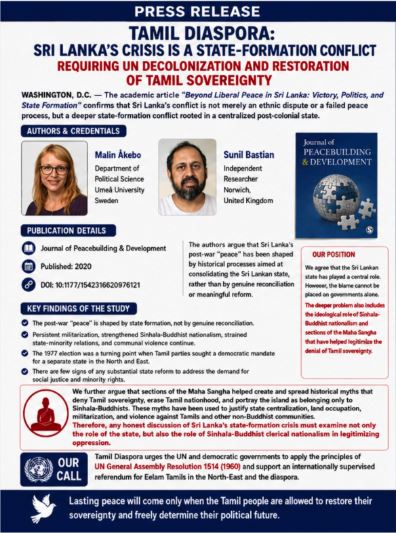
WASHINGTON, D.C. — Tamil Diaspora states that the academic article “Beyond Liberal Peace in Sri Lanka: Victory, Politics, and State Formation” confirms that Sri Lanka’s conflict is not merely an ethnic dispute or a failed peace process, but a deeper state-formation conflict rooted in a centralized post-colonial state.
The article, authored by Malin Åkebo of the Department of Political Science, Umeå University, Sweden, and Sunil Bastian, Independent Researcher, Norwich, United Kingdom, was published in the Journal of Peacebuilding & Development in 2020. The authors argue that Sri Lanka’s post-war “peace” has been shaped by historical processes aimed at consolidating the Sri Lankan state, rather than by genuine reconciliation or meaningful reform.
Tamil Diaspora agrees with the article’s core argument that the Sri Lankan state has played a central role in creating and maintaining this crisis. However, the blame cannot be placed on governments alone. The deeper problem also includes the ideological role of Sinhala-Buddhist nationalism and sections of the Maha Sangha that have helped legitimize the denial of Tamil sovereignty.
We further argue that sections of the Maha Sangha helped create and spread historical myths that deny Tamil sovereignty, erase Tamil nationhood, and portray the island as belonging only to Sinhala-Buddhists. These myths have been used to justify state centralization, land occupation, militarization, and violence against Tamils and other non-Buddhist communities. Therefore, any honest discussion of Sri Lanka’s state-formation crisis must examine not only the role of the state, but also the role of Sinhala-Buddhist clerical nationalism in legitimizing oppression.
For decades, Tamil rights were weakened through Sinhala-majority electoral power, Sinhala nationalism as state ideology, discriminatory language and education policies, land colonization, and militarization. After 2009, the so-called post-war peace continued through military occupation, state control, and Sinhala-Buddhist nationalist consolidation, not through justice or political equality.
This is why cosmetic reforms, Provincial Councils, or Colombo-controlled reconciliation cannot solve the Tamil question. When both the state structure and the dominant religious-nationalist ideology deny Tamil nationhood, the only just and lasting remedy is the restoration of Tamil sovereignty through international law, democratic consent, and UN-backed decolonization.
Tamil Diaspora urges the United Nations and democratic governments to apply the principles of UN General Assembly Resolution 1514, the 1960 Declaration on the Granting of Independence to Colonial Countries and Peoples, and support an internationally supervised referendum for Eelam Tamils in the North-East and the diaspora.
Lasting peace will come only when the Tamil people are allowed to restore their sovereignty and freely determine their political future.
The article supports the core state-formation argument by describing Sri Lanka’s post-war order through militarization, Sinhala-Buddhist nationalism, strained state–minority relations, and the lack of substantial reform for minority rights and social justice.