Response to the Catholic Association’s Statement Denying Genocide Claims in Sri Lanka’s Final War
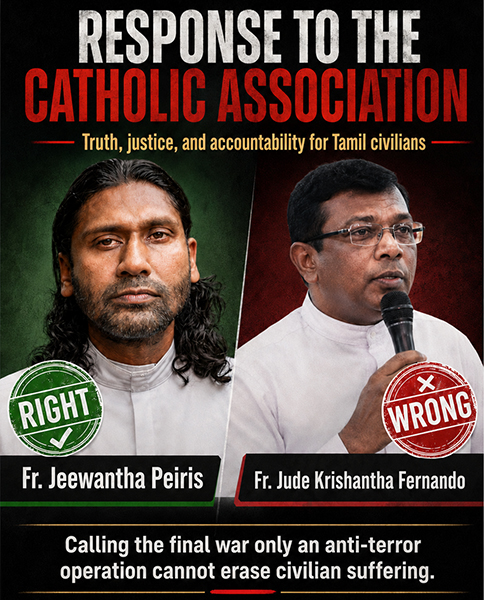
We are writing this response because the recent statement by representatives of the Catholic Church in Sri Lanka, rejecting Father Jeewantha Peiris’s remarks about genocide during the final stages of the war, has caused deep concern among Tamil survivors, victims’ families, and the Tamil diaspora.
This response is not written against the Catholic faith, Catholic people, or the Church as a religious institution. Many Catholic priests, nuns, and laypeople have courageously stood with the oppressed, comforted war victims, protected civilians, and spoken for justice during Sri Lanka’s darkest periods. We respect that moral service.
However, when any religious or institutional body describes the final stages of the war merely as “a war against terrorism” and not as a war that devastated Tamil civilians as an ethnic group, it becomes necessary to respond. Such a statement risks minimizing the mass suffering of Tamil civilians, the killings, disappearances, shelling of hospitals, attacks on No Fire Zones, denial of humanitarian aid, and the continuing pain of families still searching for their loved ones.
To describe the final stages of the war in Sri Lanka as merely “a war against terrorism” and “not a war against any ethnic group” is a political defense that ignores international evidence and the lived suffering of Tamil civilians. A government cannot erase allegations of mass civilian deaths, shelling of hospitals, attacks on so-called “No Fire Zones,” denial of food and medicine, enforced disappearances, sexual violence, militarization, land seizure, and Buddhist-Sinhala colonization simply by calling the war an “anti-terror operation.”
The United Nations Secretary-General’s Panel of Experts found credible allegations that Sri Lankan government forces killed civilians through widespread shelling, shelled hospitals and humanitarian sites, and denied humanitarian assistance during the final stages of the war. The report also recorded serious allegations against the LTTE, including the use of civilians as human shields. But the crimes of one side do not excuse or erase the crimes of the state against Tamil civilians.
The 2015 OHCHR Investigation on Sri Lanka also concluded that serious violations were committed by both sides and that some of these violations may amount to war crimes and crimes against humanity. It recommended a special judicial mechanism with international judges, prosecutors, lawyers, and investigators. This shows that the matter cannot be dismissed as a simple “war against terrorism.”
The word “genocide” is not merely an emotional term. Under Article II of the UN Genocide Convention, genocide includes acts committed with intent to destroy, in whole or in part, a national, ethnic, racial, or religious group. These acts may include killing members of the group, causing serious bodily or mental harm, and deliberately creating conditions of life intended to bring about the group’s destruction.
Therefore, the statement that “this was only a war against terrorism” does not answer the legal and moral question: What happened to Tamil civilians? Were they protected? Were hospitals protected? Were surrendering persons protected? Were the disappeared accounted for? Were the dead counted honestly? Were Tamil lands, temples, and communities protected after the war?
The Catholic Bishops’ Conference or certain Church officials may say that Father Jeewantha Peiris was not speaking as the official representative of the Catholic Church. That is their institutional position. But such a statement does not cancel international reports, survivor testimonies, satellite evidence, mass graves, or the continuing demand for justice by Tamil families of the disappeared.
Our purpose is to make clear that truth cannot be buried under institutional caution or political language. The Tamil people are not asking for revenge. They are asking for truth, justice, accountability, recognition of their suffering, and protection of their political rights.
In short, international law does not judge a war by the label a state gives it. It judges the actions, the victims, the intent, the evidence, and the accountability. Calling the final war an “anti-terrorism operation” cannot erase the mass suffering of Tamil civilians or silence the Tamil people’s demand for truth, justice, accountability, and recognition of their right to live with dignity and political freedom.
Thank you,
Tamil Diaspora News,
May 25, 2026
www.Tamildiasporanews.com