Tamils Need New Political Thinking — History Must Lead Politics
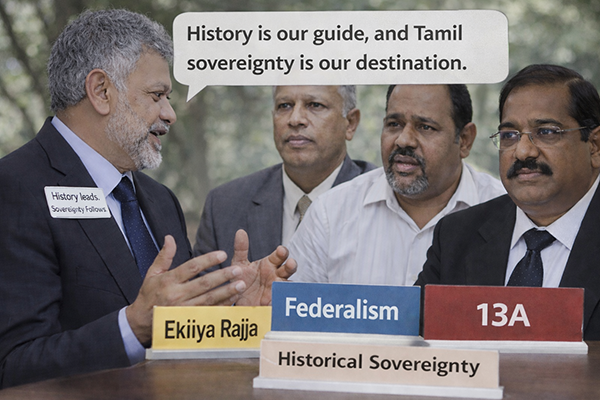
For more than seven decades, Tamil political demands have been confined within colonial and post-colonial frameworks such as the 13th Amendment, federalism, or modified versions of a unitary state. While often presented as pragmatic compromises, these approaches have consistently produced the opposite result: the steady erosion of Tamil identity, land, and political power.
Tamil political rights do not originate from colonial constitutions or post-independence arrangements.
They originate from thousands of years of continuous Tamil civilization in the Tamil homeland.
Tamil leaders must adopt new political thinking—thinking that begins with history and civilization, not with limits imposed by the Sri Lankan unitary framework. Leadership must actively show, teach, and assert Tamil civilization in the Tamil homeland, rather than repeatedly negotiating for administrative concessions that deny Tamil historical legitimacy.
Such leadership must clearly present:
- The contribution of Eelam Tamils to Sangam literature and civilization, establishing that Tamils of this island were integral to the wider Tamil civilizational world
- The flourishing of Tamil Saivam and Tamil Buddhism in the Tamil homeland, long before colonial rule
- Archaeological remains across the island—including inscriptions, settlements, burial sites, and monuments—that demonstrate Tamil civilization and Tamil rule
- The extensive network of irrigation tanks (kulams) built by Tamils, requiring organized governance, permanent settlement, and generational land stewardship
- Tamil temples in both the North and the South, proving cultural continuity, authority, and permanence across the island
Civilizations do not leave behind temporary traces.
They leave behind stone, water systems, literature, temples, and living traditions.
A Critical Message to Tamil Leadership
If Tamil leadership aligns its political position with this historical and civilizational truth—as repeatedly urged by the Tamil Diaspora—it will significantly strengthen the Diaspora’s ability to advocate internationally. It will allow us to file legal cases, submit documentation, and pursue political remedies based on the United Nations’ 1960 Decolonization framework, which recognizes the right of colonized peoples to self-determination and restoration of sovereignty.
However, continued reliance on 13A, federalism, or power-sharing within the Sri Lankan unitary framework directly undermines this effort. These demands accept a false historical premise—that Tamil political rights begin within a post-colonial state that was itself constructed by denying Tamil sovereignty.
Worse still, persisting with these frameworks risks pushing the Tamil people toward gradual disappearance from this island.
Tamil political history over the last seventy years reveals a painful and consistent pattern:
- Every compromise within the unitary state has led to loss of land
- Every accommodation has resulted in dilution of political authority
- Every constitutional settlement has accelerated cultural and demographic erosion
What has been presented as “realism” has, in practice, become managed decline.
The Choice Before Tamil Politics
Tamil leadership now faces a clear choice:
Continue asking for limited power within a system that has repeatedly dismantled Tamil existence
or
Ground Tamil politics in pre-colonial history, civilization, and international law, enabling genuine restoration through global advocacy and legal mechanisms.
Restoring Tamil sovereignty does not mean rejecting coexistence or peace. It means anchoring political solutions in historical truth, not colonial compromise. Sovereignty that was interrupted by conquest and colonial restructuring is not lost—it is to be restored.
Until Tamil politics is rebuilt on the foundation of history, archaeology, civilization, and international law, no amendment, devolution package, or administrative arrangement will deliver justice.
The future of Tamil politics must begin where Tamil history began—
with truth, dignity, and civilization.