PR: Muttukrishna Sarvananthan — Was Tamil Sovereignty Really “Mythical”?
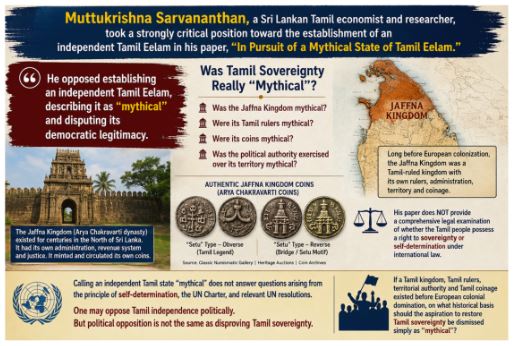
Muttukrishna Sarvananthan, a Sri Lankan Tamil economist and researcher, took a strongly critical position toward the establishment of an independent Tamil Eelam in his paper, “In Pursuit of a Mythical State of Tamil Eelam.”
Sarvananthan disputed the democratic legitimacy of the project for an independent Tamil state and chose the striking word “mythical” in describing Tamil Eelam.
But this raises an important historical question:
Was Tamil Sovereignty Itself Mythical?
Long before European colonial rule transformed the political structure of the island, the Jaffna Kingdom existed as a Tamil-ruled kingdom in northern Sri Lanka.
It had its own monarchs, political authority, administrative structures, territory and economic system. The kingdom also issued and circulated its own coinage, including coins associated with the Arya Chakravarti rulers.
These are not merely modern political slogans. They belong to the documented history of pre-colonial Sri Lanka.
Therefore, we respectfully ask Sarvananthan:
Was the Jaffna Kingdom mythical?
Were its Tamil rulers mythical?
Were its coins mythical?
Was the political authority exercised by those rulers over their territory mythical?
European colonialism did not arrive on an island organized according to today’s constitutional structure. The Portuguese, Dutch and ultimately British encountered existing political formations and progressively conquered and reorganized them.
That history deserves serious consideration whenever Tamil sovereignty is discussed.
There is another major issue with Sarvananthan’s argument. His paper does not provide a comprehensive legal examination of whether the Tamil people possess a right to sovereignty or self-determination under international law.
Calling an independent Tamil state “mythical” does not answer questions arising from the principle of self-determination, the UN Charter, relevant UN General Assembly resolutions, or the historical political status of the Tamil people.
One may oppose Tamil independence politically. But political opposition is not the same thing as demonstrating that Tamil sovereignty has no historical foundation or that Tamil self-determination has no legal basis.
The real question for Sarvananthan should therefore be:
If a Tamil kingdom, Tamil rulers, territorial authority and Tamil coinage existed before European colonial domination, on what historical basis should the aspiration to restore Tamil sovereignty simply be dismissed as “mythical”?
Thank you,
Tamil Diapora News,
USA
August 07, 2026