
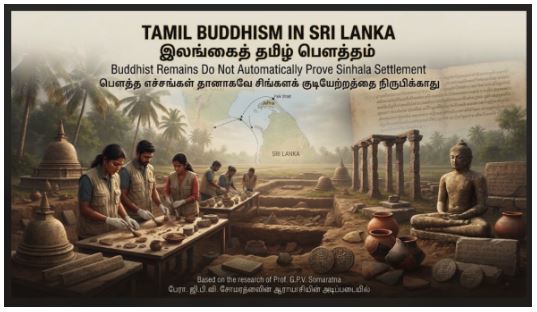
JAFFNA — August 16, 2026 — The historical existence of Tamil Buddhism in Sri Lanka presents a major challenge to the modern political claim that every ancient Buddhist monument discovered in the Tamil North and East automatically represents Sinhala settlement or Sinhala territorial ownership.
This conclusion is especially significant because it comes from Prof. G.P.V. Somaratna, former Professor of Modern History and Head of the Department of History and Political Science at the University of Colombo.
In his scholarly paper “Tamil Buddhism in Sri Lanka,” Prof. Somaratna directly questions the politicization of Buddhism and archaeology in Sri Lanka.
The Mahavamsa and the Creation of an Ownership Narrative
Prof. Somaratna makes a particularly important observation concerning the Mahavamsa and other Buddhist chronicles.
He writes that the idea that Sri Lanka belongs to Sinhala Buddhists is based upon narratives contained in fifth-century Buddhist chronicles and describes this idea as a “religious myth” that was subsequently propagated through education and exploited by political leaders.
He further argues that the Pali chronicles present the “Sinhalese side of the equation” and have omitted elements of Sri Lankan Tamil history.
This observation is critical because ancient religious literature cannot, by itself, establish modern ethnic ownership of territory.
Tamil Buddhists Were Part of Sri Lanka’s Ancient Past
Prof. Somaratna explicitly rejects the idea that Buddhism historically belonged exclusively to the Sinhalese.
His conclusion is unmistakable:
“Those who try to claim a monopoly of Buddhism as the Sinhalese national heritage run into difficulties, as Tamil Buddhists were there in Sri Lanka from the very ancient past.”
This is an important acknowledgment from a Sinhala historian.
Tamil identity and Buddhist identity were not mutually exclusive in ancient Sri Lanka.
Buddhist Archaeology Does Not Automatically Mean Sinhala Archaeology
This has enormous implications for archaeological discoveries in the Northern and Eastern Provinces.
Prof. Somaratna specifically identifies the assumption made by some Sinhala Buddhist writers: when Buddhist archaeological remains are discovered in Tamil areas, they presume that the people who lived there must therefore have been Sinhala.
Somaratna challenges that reasoning.
The existence of a stupa, Buddha image, monastery or other Buddhist object establishes Buddhist activity. By itself, it does not establish the ethnicity or language of the people who built, supported or worshipped at that site.
Therefore, Buddhist archaeological discoveries in the historical Tamil regions of Sri Lanka should not automatically be labeled “Sinhala Buddhist heritage.”
Determining who created or used a particular site requires independent evidence from archaeology, inscriptions, language, coins, settlement patterns and historical context.
Tamil Nadu and Northern Sri Lanka Were Connected Through Buddhism
Prof. Somaratna also emphasizes the importance of ancient Tamil Buddhism across the Palk Strait.
He writes:
“The presence of Buddhism in Ancient Tamilnadu has a great impact on the Buddhist activities in Sri Lanka and the northern part of the island in particular.”
His study discusses Buddhist activity under the Pallavas and Cholas, Kanchipuram’s Buddhist tradition, Tamil Buddhist literature such as Manimekalai, and interaction between Buddhist monks of Tamil Nadu and Sri Lanka.
This evidence demonstrates that Buddhism in northern Sri Lanka cannot responsibly be studied while separating Jaffna from the wider Buddhist history of the Tamil-speaking world.
Kandarodai and Vallipuram Require Evidence, Not Ethnic Assumptions
The archaeological evidence from Kandarodai and Vallipuram is particularly important.
Somaratna discusses Buddhist monuments at Kandarodai alongside Black-and-Red Ware, Brahmi inscriptions, Roman coins, early Pandyan coins, early Chera coins and other archaeological material.
At Vallipuram, the famous gold-plate inscription establishes the existence of a Buddhist vihara. Somaratna also records the scholarly disagreement concerning what that inscription can tell us about the political and ethnic character of ancient Jaffna.
This is precisely why archaeology must be interpreted carefully.
A Buddhist monument proves Buddhism. It does not, without additional evidence, prove Sinhala ethnicity.
Buddhism Cannot Be Used as an Automatic Territorial Marker
For generations, archaeological discoveries of Buddhist remains in the Tamil North and East have sometimes been presented politically as evidence that these territories were historically Sinhala.
Prof. Somaratna’s study demonstrates the fundamental problem with that argument: Tamil Buddhists existed.
Ancient Tamil Nadu possessed a substantial Buddhist intellectual and religious tradition, and Somaratna specifically identifies its influence upon northern Sri Lanka.
Accordingly, every Buddhist archaeological discovery in the Tamil homeland must be investigated on its own evidence rather than being automatically converted into evidence of Sinhala settlement.
Tamil Buddhist possibilities must be treated as a legitimate part of the historical inquiry.
History Must Be Established by Evidence
Prof. Somaratna begins his study with a warning that remains extremely relevant today:
“Whoever possesses the history possesses the country, possesses the right to rule, the right to exist.”
That is precisely why archaeology should never be transformed into a tool of modern ethnic territorial politics.
Tamil Buddhism is part of Sri Lanka’s history. Its existence undermines the simplistic equation:
Buddhist = Sinhala = Sinhala territory.
The historically responsible equation is much simpler:
Buddhist evidence proves a Buddhist presence. Ethnicity must be independently established.
Recognizing that distinction protects archaeology from nationalism and allows the ancient history of the Tamil people—including their forgotten Buddhist heritage—to be studied on the basis of evidence rather than modern political claims.
Source: G.P.V. Somaratna, Tamil Buddhism in Sri Lanka.