
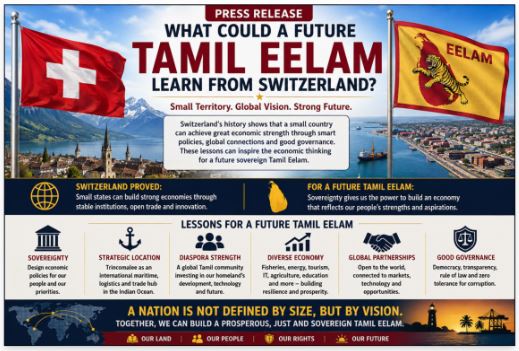
What Could a Future Tamil Eelam Learn from Switzerland? Small Territory Does Not Mean an Economically Weak State
The debate over the future of the Tamil homeland should not be limited to the question of territorial size. International experience demonstrates that a geographically small state can build substantial economic influence when it possesses effective institutions, access to international markets, an educated population, and the ability to formulate its own economic policies.
A study by Swiss historian Jakob Tanner, Krisen und Konjunkturen des Kapitalismus in der Schweiz des 20. Jahrhunderts, provides an interesting case for considering this question.
The study is not about Sri Lanka or Tamil Eelam. It examines Switzerland’s economic development. Nevertheless, some of the historical experience described by Tanner may provide useful lessons when considering the economic possibilities of a future sovereign Tamil Eelam.
Switzerland: Small Territory, Global Economic Reach
Tanner describes Switzerland as a small, open economy whose economic influence became much larger than its territorial size might suggest.
Switzerland developed an international economic model involving a strong currency, relatively low taxation, international finance, trade, investment, and globally operating companies. The study describes a striking contrast between Switzerland’s small territorial size and its considerable economic capacity.
This is an important lesson:
The economic viability of a country cannot be determined simply by looking at the size of its territory.
Switzerland demonstrates that a small state can connect itself to a much larger international economy.
Sovereignty Can Provide Economic Choices
Another important element of the Swiss experience is the ability of a sovereign state to establish its own economic and regulatory framework.
Switzerland was able to develop policies suited to its particular circumstances while participating extensively in international commerce.
For a future Tamil Eelam, sovereignty could similarly provide the political space to design economic policies specifically around the strengths and requirements of the Tamil homeland rather than relying exclusively on economic decisions made by a centralized government elsewhere.
Such policies could potentially include:
▪ development of Trincomalee as an international maritime and logistics center;
▪ expansion of fisheries and marine industries;
▪ information technology and knowledge-based industries;
▪ renewable energy;
▪ tourism;
▪ agriculture and value-added food production;
▪ incentives for international investment;
▪ and structured investment from the global Tamil diaspora.
These possibilities are proposals for future consideration; they are not claims made by Tanner’s study.
The Tamil Diaspora Could Be an Economic Advantage
A future Tamil economic strategy would also possess an asset that many small states seek to develop: an internationally dispersed population with professional, entrepreneurial, technological, and financial connections.
Tamil communities are established across North America, Europe, Australia and other regions.
A properly governed Tamil homeland could seek to transform those international connections into investment, technology transfer, entrepreneurship, educational partnerships and access to global markets.
Switzerland’s experience illustrates a broader principle: economic networks can extend far beyond national borders.
Geography Can Be an Asset
The Tamil homeland’s position along major Indian Ocean maritime routes could also become an economic advantage.
Trincomalee’s natural harbor, proximity to India, access to the Bay of Bengal and connections to international shipping routes deserve serious consideration in any long-term Tamil economic strategy.
Instead of asking only whether a Tamil state would be geographically small, the more important questions are:
What resources would it possess?
What international markets could it access?
What institutions would it build?
How could its diaspora participate in its development?
Economic Independence Requires Good Governance
The Swiss example should not be romanticized or copied blindly. Tanner’s study also discusses serious controversies surrounding Switzerland’s economic model, including tax avoidance, banking secrecy, capital flight and the country’s relationship with global financial power.
Therefore, the lesson for Tamils should not be simply to reproduce Switzerland’s policies.
The larger lesson is that small states can develop economic models appropriate to their own circumstances while maintaining extensive international economic relationships.
A future Tamil Eelam would need democratic institutions, transparency, rule of law, protection of property and human rights, responsible public finances and strong safeguards against corruption.
A Future Tamil State Must Be Planned, Not Merely Imagined
The discussion of Tamil sovereignty should therefore include serious economic planning.
Political sovereignty and economic viability should be examined together.
A future Tamil administration could begin developing detailed studies of taxation, ports, fisheries, energy, infrastructure, education, technology, diaspora investment and international trade.
Switzerland’s history demonstrates an important point for this discussion:
A nation’s strength is not measured simply by the number of square kilometers on a map.
For Tamils considering their political and economic future, the relevant question is not merely:
“Is Tamil Eelam large enough?”
The better question is:
“What could Tamils build if they possessed the political institutions and economic authority to determine their own future?”
That is a question deserving serious economic research and international discussion.