August 23, 2026 — Tamil Diaspora News
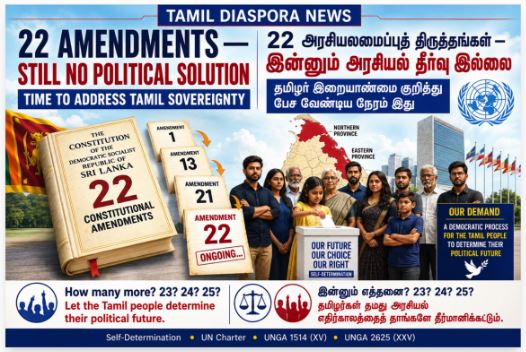
Sri Lanka’s continuing cycle of constitutional amendments raises a fundamental question for Tamils: How many more constitutional amendments must be attempted before acknowledging that constitutional reform has failed to produce a durable settlement of the Tamil national question?
A recent analysis by Rajan Philips in The Island, examining Sri Lanka’s constitutional history “from the First to the 22nd,” highlights decades of amendment politics and repeated frustrations surrounding constitutional reform.
Since the 1978 Constitution came into operation, successive governments have repeatedly amended it. These amendments have dealt with presidential powers, elections, institutions, the judiciary and other aspects of governance. Yet the fundamental political dispute concerning meaningful Tamil self-government remains unresolved.
The 13th Amendment, introduced in 1987, established Provincial Councils and a framework for devolution. Nearly four decades later, it has not produced an enduring political settlement of the Tamil national question.
The 21st Amendment, enacted in 2022, primarily restored institutional checks, including the Constitutional Council. The proposed 22nd Amendment represents yet another constitutional change. Neither provides a comprehensive political settlement for the Tamil people.
How Many More Amendments?
If 22 rounds of constitutional amendment politics have failed to produce an enduring solution, why should Tamils continue waiting for Amendment 23, 24 or 25?
Rather than continuing an endless cycle of constitutional adjustments, Sri Lanka and the international community should recognize the need for a genuine democratic process through which Tamils can freely express and determine their preferred political future.
The repeated failure to achieve a durable settlement within the existing constitutional framework provides compelling grounds to reopen the discussion about Tamil sovereignty and the exercise of Tamil self-determination through peaceful and democratic means.
Self-Determination Is Recognized in International Law
The principle of self-determination of peoples is recognized in international law, including in the UN Charter and major United Nations instruments. UN General Assembly Resolutions 1514 (XV) and 2625 (XXV) affirm important principles concerning self-determination and the political status of peoples.
These principles do not automatically give every people an unconditional right to establish a separate state. However, they establish that self-determination is a serious international legal principle and that peoples’ freely expressed political aspirations cannot simply be dismissed.
After decades of unsuccessful constitutional reform, Tamil sovereignty should no longer be treated merely as a political slogan. It should be considered as part of a legitimate democratic discussion about self-determination, equality and the freely expressed political will of the Tamil people.
Twenty-two amendments are enough. It is time to ask the Tamil people directly what political future they want.
Tamil Diaspora News
August 23, 2026