
Important New Information Everyone Should Know
Tamil Diaspora News – Health Awareness
A heart attack does not always begin with severe or crushing chest pain.
A newly updated medical definition of heart attack is designed to help doctors recognize different ways heart muscle can be damaged—and it may be particularly important for women, whose heart attacks can sometimes be harder to recognize.
The Most Important Message
Do not assume that you are not having a heart attack simply because you do not have severe chest pain.
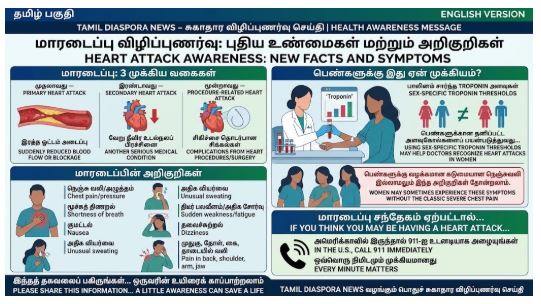
Doctors now classify heart attacks more simply into three broad categories:
1. Primary Heart Attack
This happens when blood flow through a coronary artery is suddenly severely reduced or blocked, damaging the heart muscle.
2. Secondary Heart Attack
This happens when another serious medical condition creates an imbalance between the amount of oxygen the heart needs and the amount it receives.
3. Procedure-Related Heart Attack
This refers to heart attacks associated with certain heart procedures or cardiac surgery.
Why Is This Especially Important for Women?
Doctors commonly use a blood test for a protein called troponin to detect injury to the heart muscle.
Normal troponin levels can differ between women and men. The updated definition emphasizes sex-specific troponin reference limits, which may help doctors identify heart injury in women that might otherwise be overlooked.
This is important because women do not always experience what people think of as the “classic” heart-attack symptoms.
Don’t Look Only for Chest Pain
Possible warning signs can include:
Chest pain, pressure or discomfort
Shortness of breath
Nausea
Unusual or sudden fatigue
Sweating
Dizziness or light-headedness
Pain or discomfort in the back, shoulder, arm or jaw
These symptoms do not necessarily mean someone is having a heart attack, but potentially serious symptoms should not be ignored.
An Important Message to the Tamil Community
“I don’t have chest pain, so it can’t be a heart attack” can be a dangerous assumption.
Women in particular should not automatically dismiss unexplained shortness of breath, nausea, unusual exhaustion, or upper-body discomfort as simply tiredness, indigestion, or stress.
If you think you may be having a heart attack, seek emergency medical attention immediately. In the United States, call 911.
When a heart attack occurs, every minute can matter. Early diagnosis and treatment can limit damage to the heart—and may save a life.
Tamil Diaspora News
Please share this information with your family and friends.
A few minutes of awareness today could help save someone’s life tomorrow.
This article is for general health awareness and is not a substitute for medical advice, diagnosis, or emergency care.