Tamil Diaspora News expresses serious concern regarding the analysis presented by Dr. Shyamika Jayasundara-Smits of the International Institute of Social Studies at Erasmus University. Although her work criticizes Sinhala-Buddhist hegemony, state violence and the Rajapaksa administration, it fails to recognize the Tamil national question in its full historical and political context.
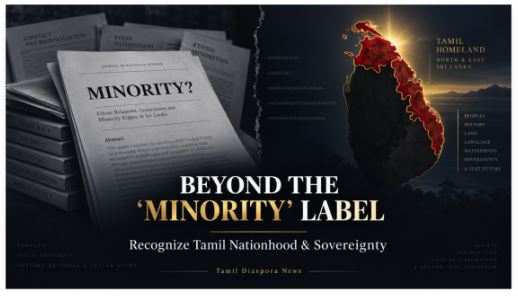
The study repeatedly describes Tamils as a “minority.” This terminology is not politically neutral. It reduces a historically rooted people—with a distinct language, territorial homeland and political identity—to a permanent numerical minority within the boundaries of the Sri Lankan state.
Sri Lankan Tamils are not merely a scattered minority seeking concessions from a majority. They constitute a people claiming nationhood and the right to self-determination in their traditional homeland in the North and East.
The author also presents the conflict largely as a struggle within the Sinhala ruling class. While competition among Sinhala political elites contributed to ethnic mobilization, this framework risks pushing the experiences of Tamils to the margins. It cannot adequately explain systematic discrimination, anti-Tamil pogroms, militarization, land appropriation, enforced disappearances and the repeated failure of constitutional arrangements to protect Tamil rights.
The Tamil demand for sovereignty must not be reduced to the history, conduct or political position of the LTTE. Tamil sovereignty did not begin with the armed struggle. It arises from a much older historical and political question, including the existence of the Jaffna Kingdom and the separate administration of Tamil territories before European colonial powers unified the island under a single governmental structure.
Although the paper records the Thimphu Principles—recognition of the Tamils as a distinct nation, recognition of their homeland and acknowledgment of their right to self-determination—it does not seriously examine the legitimacy of those principles. Instead, it returns to democratic reform within the existing Sri Lankan state.
After decades of broken agreements, abandoned negotiations and the non-implementation of even limited devolution, calls for “deep democracy” cannot substitute for a direct examination of Tamil sovereignty. A state-centred solution assumes that the existing state is the unquestionable political framework. That is precisely what must be critically examined.
We acknowledge that Dr. Jayasundara-Smits is not an uncomplicated defender of Sinhala nationalism. Her descriptions of Sri Lanka as a Sinhala-Buddhist hegemonic state and of the post-war order as a “victor’s peace” are important. Nevertheless, identifying Sinhala hegemony while continuing to frame Tamils principally as a minority produces a fundamental contradiction.
Academic research concerning Sri Lanka must move beyond asking how Tamils can be accommodated within a Sinhala-majoritarian state. It must also confront the deeper question:
Why should the pre-existing nationhood, homeland and political sovereignty claimed by the Tamil people remain permanently subordinate to a state consolidated through colonial rule?
Tamil sovereignty is not merely an extension of one organization, one war or one period of leadership. It is a historical, democratic and political claim that deserves independent examination through colonial history, material evidence and the principles of self-determination.
Tamil Diaspora News therefore calls upon scholars to examine the Tamil national question on its own merits—not solely through Sinhala elite politics, the “minority” framework or the history of the armed conflict.
Recognizing Sinhala-Buddhist hegemony is only the beginning. Recognizing Tamil nationhood and examining the restoration of Tamil sovereignty must be the next step.
— Tamil Diaspora News