
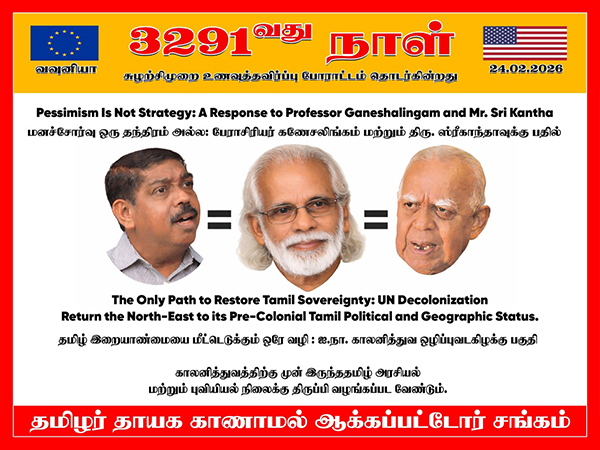
Pessimism Is Not Strategy: A Response to Professor Ganeshalingam and Mr. Sri Kantha*
Statement from the Tamil Mothers of Vavuniya
The Tamil Mothers of Vavuniya — now in their 10th year of uninterrupted roadside protest, standing under sun and rain holding photographs of their forcibly disappeared children — issue this statement with heavy hearts and unbroken resolve.
For nearly a decade, we have waited for truth.
We have waited for justice.
We have waited for answers about our children — and those answers have never come.
It is from this lived reality — not from academic distance — that we respond to the recent remarks made by Professor Ganeshalingam and Mr. Sri Kantha.
Professor Ganeshalingam and Mr. Sri Kantha have argued that Tamil political aspirations lack geopolitical viability and must remain confined within a united Sri Lanka. Many see this position as politically regressive and disconnected from the unfinished question of decolonization.
The position they advance closely mirrors the united-Sri Lanka framework long associated with the late R. Sampanthan. That accommodation-centered approach, in the view of many Tamils, failed to secure meaningful autonomy, justice, or structural change. Over time, it lost significant public confidence. Repeating that model today does not restore its credibility.
After nearly eighty years of broken promises, abrogated agreements, failed pacts, and structural discrimination, the call to once again pursue a “solution within a united Sri Lanka” does not represent strategic realism. It represents the recycling of a framework that has repeatedly failed.
For decades, Tamils were told to wait:
Wait for constitutional reform.
Wait for federalism.
Wait for meaningful devolution.
Each time, the result was dilution, delay, or outright reversal.
The Bandaranaike–Chelvanayakam Pact was torn up.
The Dudley–Chelvanayakam Pact was abandoned.
Constitutional reforms further centralized power instead of devolving it.
At what point does patience become political surrender?
Tamil political identity did not begin in 1948. It did not begin with post-colonial constitutional arrangements. It predates European colonization.
The 1960 UN Declaration on the Granting of Independence to Colonial Countries and Peoples (UNGA Resolution 1514) affirms that all peoples have the right to self-determination. If colonial restructuring permanently erased a distinct political entity, that does not mean decolonization was properly completed.
The International Court of Justice’s advisory opinion concerning Mauritius and the Chagos Archipelago (Diego Garcia) confirmed that where colonial powers unlawfully detached territories, decolonization remained incomplete.
If these principles apply elsewhere in the world, why should they be dismissed here?
Professor Ganeshalingam argues that because India and China maintain a geopolitical balance, there is no space for Tamil political aspirations. This assumes geopolitical conditions are permanent.
History proves otherwise.
Kosovo did not emerge because global powers initially prioritized it.
East Timor did not gain independence because it was convenient.
South Sudan did not materialize from goodwill alone.
Geopolitical conditions shifted.
Pressure accumulated.
International legal arguments were advanced.
Political space was constructed.
Geopolitics is not static — it evolves.
Reducing Tamil self-determination to a mere administrative issue ignores its deeper historical and legal foundations. It transforms a national question into a management problem.
This is not strategy. It is accommodation.
We — mothers who have waited nearly a decade for answers about our disappeared children — know the cost of waiting. We know the cost of misplaced trust. We know what it means to be told to be patient while injustice becomes permanent.
Political realism does not mean abandoning fundamental rights.
Sovereignty is not a slogan — it is a right under international law.
Declaring weakness does not strengthen a people.
Strategic clarity does.
The process of decolonization remains unfinished.
Pessimism is not strategy.