
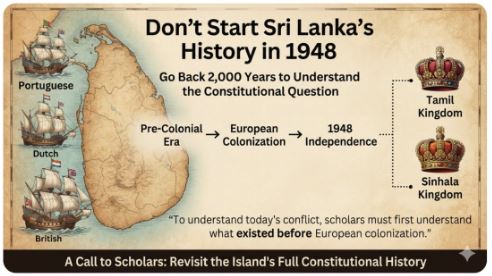
A Request to Scholars: Don’t Begin Sri Lanka’s History in 1948
Many academic papers examining Sri Lanka’s ethnic conflict begin their analysis in 1948, the year Ceylon gained independence from Britain. By doing so, they unintentionally overlook the deeper historical context that shaped today’s conflict.
To understand Sri Lanka’s constitutional crisis, scholars should not begin with 1948—they should go back more than 2,000 years and examine the island’s political evolution before European colonization.
For centuries, the Tamil and Sinhala peoples developed their own kingdoms, administrations, cultures, and political institutions. British colonial rule eventually merged these distinct political entities into a single colony for administrative convenience. When Britain granted independence in 1948, it transferred power to a unitary state without first obtaining the consent of all peoples who had lived under separate political systems before colonization.
As a result, many analyses focus only on the failures that occurred after independence—constitutional reforms, language policies, riots, civil war, devolution, and reconciliation—without examining whether the constitutional foundation created during colonial rule itself deserves re-evaluation.
After nearly eight decades of failed agreements, repeated constitutional reforms, armed conflict, and continuing political disputes, it is fair to ask whether scholars should broaden the discussion beyond devolution and federal arrangements.
Academic research should also examine questions such as:
What was the constitutional status of the Tamil and Sinhala kingdoms before European colonization?
▪ How did Portuguese, Dutch, and British rule transform those political entities?
▪ Did independence in 1948 restore the sovereignty that existed before colonization, or did it simply transfer colonial authority to a new central government?
▪ Should principles of self-determination and decolonization be considered when discussing Sri Lanka’s constitutional future?
These questions deserve careful historical and legal examination.
For decades, proposed solutions have largely focused on power-sharing within the existing state. Yet those proposals have repeatedly failed to produce a lasting political settlement. Scholars should therefore be willing to revisit the island’s pre-colonial constitutional history and consider whether the restoration of the distinct political sovereignty that existed before European colonization should also form part of the academic discussion.
If academia seeks lasting solutions, it should not begin Sri Lanka’s story in 1948. It should begin where the constitutional transformation actually started—with the arrival of European colonial powers and the political changes they imposed on the island.