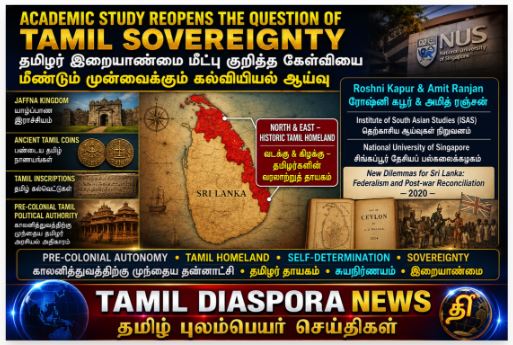
A scholarly study by Roshni Kapur and Amit Ranjan of the Institute of South Asian Studies (ISAS), National University of Singapore, titled “New Dilemmas for Sri Lanka: Federalism and Post-war Reconciliation” (16 April 2020), provides important academic context for understanding why the Tamil national question cannot simply be reduced to post-war economic development or limited administrative devolution.
The authors discuss Tamil political claims in the context of pre-colonial autonomy and ethnic nationhood and examine the continuing conflict between these claims and the Sinhala-Buddhist conception of Sri Lanka as an essentially unitary state.
This historical point is critical. The Tamil demand for political authority in the North-East did not suddenly arise after Sri Lankan independence or during the armed conflict. Pre-colonial Tamil political authority, including the Jaffna Kingdom, existed before European colonial powers consolidated the island under a single administration. Therefore, the question deserves to be examined not merely as a request for concessions from Colombo, but also through the historical and legal principles of self-determination and sovereignty.
Kapur and Ranjan also discuss the post-war environment in terms of a “victor’s peace,” militarisation, and a continuing Sinhala-Buddhist spatial-territorial project in the North-East. These observations raise serious questions about whether economic development without genuine political power-sharing can constitute reconciliation.
Although the authors primarily examine federalism and devolution rather than explicitly advocating an independent Tamil state, their discussion of pre-colonial Tamil autonomy brings the deeper sovereignty question back into focus.
After decades of unsuccessful constitutional negotiations and incomplete devolution, Tamil political discourse should therefore go beyond repeatedly asking how much power Colombo is prepared to devolve. A legitimate question for academics, policymakers and the international community is:
Should the historical sovereignty and right of self-determination of the Tamil people also be examined as part of a durable political settlement?
For Tamils, genuine reconciliation must involve more than development projects. It must address political authority, territorial security, historical identity, accountability and the freely expressed political will of the Tamil people.
Tamil Diaspora News