
Clinton–Rajapaksa Contacts, the Akuressa Bombing, and Questions That Require Investigation
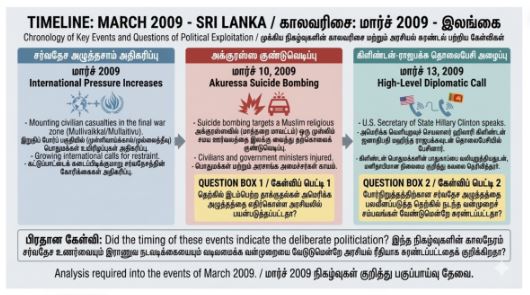
In March 2009, as civilian casualties were mounting in the final war zone around Mullivaikkal and Mullaitivu, international pressure on the Sri Lankan government was increasing.
On March 10, 2009, a suicide bombing struck a Muslim religious procession at Akuressa in Matara District. Civilians were killed and several government ministers were among those injured.
During this same critical period, disturbing reports were emerging about large numbers of Tamil civilian casualties in the Mullaitivu conflict zone.
Three days later, on March 13, 2009, then-U.S. Secretary of State Hillary Clinton spoke by telephone with President Mahinda Rajapaksa. Clinton subsequently stated that she had urged the Sri Lankan government not to fire into areas populated by civilians and had expressed serious concern about the deteriorating humanitarian situation.
The close timing of these developments raises questions that deserve examination.
Were attacks in southern Sri Lanka, including the Akuressa bombing, politically used to counter growing American pressure to halt or restrict military operations in the Tamil civilian areas?
Did such attacks strengthen the government’s argument to Washington and other governments that Sri Lanka remained under an immediate terrorist threat and therefore needed to continue its military campaign?
There is also a more serious allegation raised within sections of the Tamil community:
Were violent incidents in the South deliberately permitted, manipulated, or politically exploited to weaken international pressure for a ceasefire and to prevent possible international humanitarian intervention near Mullaitivu?
At the time, reports indicated that the United States was examining possible humanitarian evacuation options involving U.S. military or naval capabilities. This has contributed to longstanding questions over whether Colombo sought to prevent any foreign intervention that could have interrupted the final military offensive.
However, it is important to distinguish these questions from established facts. There is presently no publicly established evidence proving that the Rajapaksa government organized the Akuressa bombing, or that the attack was created specifically to prevent a U.S. warship from approaching Mullaitivu.
That is precisely why an independent investigation is necessary.
Anura Government Should Investigate
The government of President Anura Kumara Dissanayake should investigate the chronology and determine whether any connection existed between these events.
The investigation should establish:
▪ What humanitarian evacuation or naval options did the United States actually consider?
▪ Was a U.S. vessel ever formally ordered or prepared to approach the Mullaitivu area?
▪ Why was any proposed humanitarian operation ultimately abandoned?
▪ What exactly did Secretary Clinton communicate to President Rajapaksa?
▪ How did the Rajapaksa government respond to American pressure concerning civilian casualties and a possible cessation of hostilities?
▪ Was the Akuressa attack subsequently used by the government to justify continuing military operations?
▪ Did Sri Lankan intelligence agencies possess advance information concerning the attack?
▪ Is there any evidence that officials deliberately permitted, facilitated, concealed, or manipulated an attack for political or military purposes?
These questions should be answered through Sri Lankan and U.S. government records, diplomatic communications, military documentation, intelligence records, and testimony from officials involved at the time—not through speculation.
If the allegations are false, an independent investigation should establish that.
If evidence demonstrates that attacks or civilian deaths were deliberately permitted, concealed, manipulated, or exploited to influence international governments and prolong military operations, those responsible must be held accountable regardless of their former position or political power.
The Tamil civilians who died in Mullivaikkal and the civilians killed in attacks elsewhere in Sri Lanka all deserve the truth.
The Anura Kumara Dissanayake government has an opportunity to provide that truth through an independent and transparent investigation.