Tamil Diaspora News – April 26, 2026
Tamils suspect that some Buddhist monks are supplying drugs to Tamil youth in Eelam to undermine the Tamil sovereignty struggle.
The Tamil homeland in the North-East is confronting a dangerous and escalating drug crisis—one that threatens not only public health, but the very survival, identity, and future of the Tamil people.
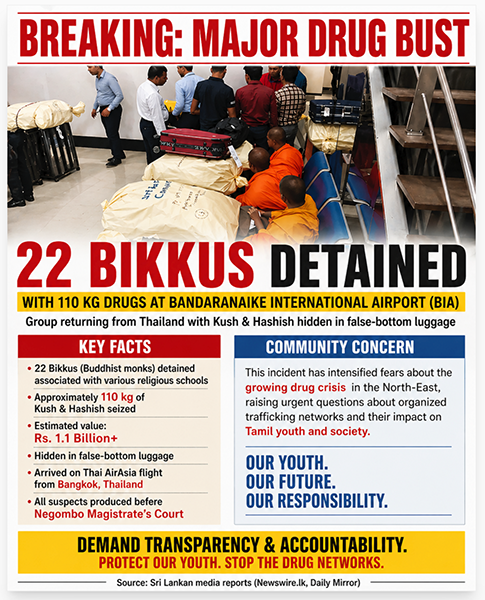
Recent reports of the arrest of 22 individuals, including Buddhist monks, allegedly linked to drug trafficking from Thailand, have intensified fears that organized and possibly protected networks are operating within Tamil regions. These developments have triggered widespread concern that the Tamil homeland is being systematically destabilized.
Tamils are asking:
Is the destruction of Tamil youth being allowed—or enabled?
This is not an isolated issue. It is part of a broader pattern of structural insecurity, demographic pressure, and social erosion in the Tamil homeland.
International Legal Framework: Right to Protection and Self-Determination
Under UN General Assembly Resolution 1514 (1960), all peoples have the inalienable right to self-determination, including the right to freely determine their political status and protect their economic, social, and cultural development.
When a people are unable to protect their society from systemic harm, instability, or externally driven threats, the international community has a duty to recognize and respond.
The situation in the Tamil homeland increasingly reflects conditions where:
- Local populations lack control over security and governance
- Harmful networks operate without effective accountability
- Communities are exposed to long-term social destruction
Kosovo Precedent: Protection When Internal Safeguards Fail
The Kosovo precedent, recognized through international legal developments and the International Court of Justice (ICJ) advisory opinion, established that when a population faces systematic insecurity and lack of meaningful protection, alternative political solutions—including external intervention and self-governance mechanisms—can become legitimate considerations.
Tamils assert that:
- A people cannot be expected to remain under conditions where their youth are destroyed, land is destabilized, and security is compromised
- When internal systems fail, international oversight and political solutions must be explored
Urgent Demands
The Tamil diaspora and homeland communities call for:
- An independent international investigation into drug trafficking networks in the North-East
- Full transparency and accountability for all individuals involved, regardless of status
- Immediate protective measures for Tamil youth and communities
- International monitoring mechanisms to ensure long-term security
- Recognition that lasting protection requires political solutions grounded in the right to self-determination
“A people cannot survive if their youth are destroyed and their society is destabilized. Protection is not optional—it is a legal and moral obligation.”
Tamils worldwide warn that continued inaction will:
- Deepen instability
- Destroy future generations
- Further erode trust in existing governance structures
The international community—including the United States, European Union, and United Nations—must act decisively.
The Tamil people have the right to live in dignity, security, and freedom—free from drugs, fear, and systemic destabilization.
Thank you,
Tamil Diaspora News,
April 26, 2026