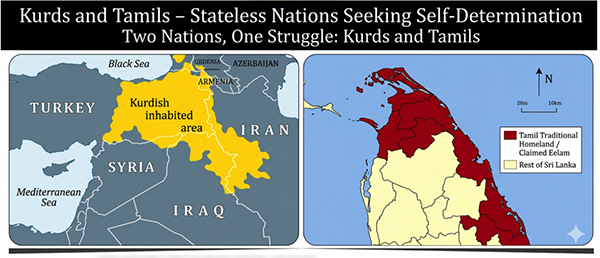
Across the world, stateless nations continue to seek recognition, dignity, and political self-determination. The experiences of communities such as the Kurds and the Tamils demonstrate how geopolitical realities, shifting alliances, and demographic transformations can shape — and often constrain — the aspirations of nations without sovereign states.
The Kurdish people, one of the largest stateless nations in the world, have long experienced political fragmentation across multiple states. Their situation is often summarized by the well-known Kurdish phrase: “No friends but the mountains.” Kurdish political aspirations have frequently been influenced by regional geopolitics, where international alliances and strategic interests shape the possibilities for autonomy or independence.
Many Tamil advocates argue that a similar dynamic has shaped the political trajectory of the Tamil people in Sri Lanka. Following independence in 1948, the island’s political system increasingly centralized power within a majoritarian framework, leaving Tamil political aspirations unresolved despite decades of political negotiations, conflict, and international attention.
Decolonization and the Tamil Question
Advocates of Tamil sovereignty therefore argue that:
- The Tamil people constitute a distinct nation with historical territorial ties to the North and East of the island.
- Colonial administrative unification created a state structure that did not reflect pre-existing political realities.
- The principle of decolonization should allow historically distinct nations to determine their own political future.
From this perspective, the Tamil issue is not merely a question of minority rights within an existing state framework, but a broader question of political sovereignty and national self-determination.
Sovereignty and Democratic Choice
Supporters of Tamil self-determination argue that a durable and just political settlement must involve:
- Recognition of the Tamil nation and its historical homeland in the North and East.
- Addressing structural and demographic changes that have altered the political landscape of Tamil regions.
- Ensuring that the democratic will of the Tamil people determines their political future.
- International engagement that supports a peaceful and democratic process addressing questions of political sovereignty.
Geopolitics and Stateless Nations
The experiences of both the Kurds and the Tamils highlight a broader challenge in international politics: the tension between the principle of self-determination and the realities of state sovereignty and geopolitical interests.
For stateless nations, international support often fluctuates depending on strategic considerations, leaving long-standing political aspirations unresolved.
Advocates argue that sustainable peace and stability can only emerge when political arrangements reflect the democratic aspirations and historical identities of the peoples concerned.
Thank you,
Tamil Diaspora News,
March 15, 2026