Trincomalee Is Not a Military Playground — It Is Tamil Homeland
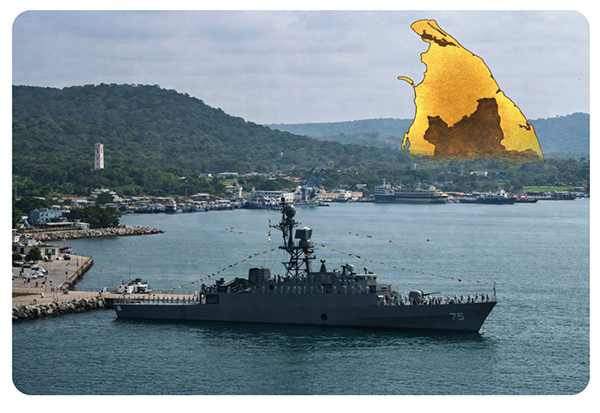
A recent New York Times report (March 5, 2026) revealed that Sri Lanka has taken custody of an Iranian naval vessel in Trincomalee, after a U.S. submarine torpedoed another Iranian ship in nearby waters. The article describes how Sri Lanka’s neutrality is being tested as global conflict spills into the Indian Ocean.
But for the Tamil people, this is not simply a neutrality issue.
Trincomalee is part of the historic Tamil homeland in the North-East.
It is one of the deepest natural harbors in the world — strategically protected, structurally superior, and long recognized for its military value. Its selection as a holding point for foreign naval vessels underscores precisely why control over this port has always been politically consequential.
Under UN General Assembly Resolution 1514 (1960) — the Declaration on the Granting of Independence to Colonial Countries and Peoples — all peoples possess the right to self-determination. The British transfer of power in 1948 did not include a separate act of self-determination for the Tamil nation. Two historically distinct political entities were merged without consent.
The consequences of that unresolved political question continue today.
The North-East remains heavily militarized. Strategic decisions affecting Trincomalee are made without the democratic consent of the Tamil people. Now, once again, Tamil territory is being drawn into international military tensions.
We state clearly:
- The Tamil homeland must not be used as a strategic buffer in great-power rivalries.
- Militarization of Trincomalee without Tamil political authority is a continuation of structural injustice.
- Strategic ports in the North-East cannot be separated from the question of Tamil self-determination.
This moment exposes a deeper reality: unresolved decolonization creates geopolitical instability.
We call upon the United States and the international community to:
- Re-examine Sri Lanka’s post-colonial settlement under the principles of UN Resolution 1514;
- Recognize that durable regional stability requires addressing the Tamil national question;
- Support a peaceful, internationally supervised political process that reflects the will of the Tamil people.
A future political arrangement recognizing Tamil sovereignty would ensure that ports like Trincomalee are governed transparently, demilitarized, and not used to intensify international conflict.
The Tamil struggle is not about war.
It is about lawful self-determination, dignity, and the right to decide how our homeland is used.