The United States and the international community now face a historic moment to address one of the world’s longest unresolved decolonization issues — the political future of the Tamil nation in the island historically known as Eelam.
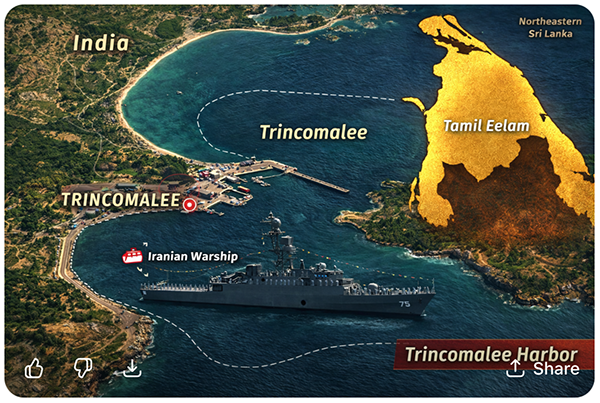
Recent developments in the region highlight why this issue can no longer be ignored. Iranian naval vessels have sought refuge in Sri Lankan waters during escalating tensions in the Indian Ocean region. The strategic harbor of Trincomalee must never become a safe haven for Iranian military vessels or any authoritarian power seeking to exploit the Indian Ocean for military purposes. If Tamil sovereignty had existed, the people of Eelam would never have allowed undemocratic regimes to use Trincomalee as a shelter during wartime.
Under the 1960 United Nations Declaration on the Granting of Independence to Colonial Countries and Peoples (UNGA Resolution 1514), all peoples possess the right to self-determination and sovereignty. The Tamil nation in the North and East of the island was never given that right when the British abruptly transferred power in 1948 to a Sinhala-majority state.
Before European colonization by the Portuguese, Dutch, and British, the Tamil people maintained their own sovereign kingdom and political institutions. The forced merger of two historically distinct nations under a single post-colonial state created decades of instability, discrimination, and ultimately catastrophic violence against the Tamil population.
The Tamil people are a distinct nation, separate from the Sinhalese by language, religion, culture, and historical identity. The Tamil struggle for sovereignty is therefore not merely a domestic political issue but a decolonization question under international law, similar to other national struggles for self-determination.
If the United States supports the peaceful restoration of Tamil sovereignty in the North and East, the Tamil people are prepared to establish a long-term strategic partnership with the United States lasting up to 100 years.
Such cooperation could include strategic and economic development in key locations such as:
- Trincomalee Harbor, one of the deepest natural harbors in the world
- Delft Island (Neduntheevu) in the northern seas
These locations could support future global initiatives including:
- AI data centers and advanced digital infrastructure
- Large-scale wind and solar renewable energy projects
- Maritime security cooperation in the Indian Ocean
- Technology and logistics hubs connecting Asia and global markets
The Tamil people have lived on this island for thousands of years, maintaining a continuous civilizational presence long before the modern Sri Lankan state emerged. The restoration of Tamil sovereignty would correct a historic injustice while creating a stable democratic partner in one of the world’s most strategic maritime regions.
The US Tamil Diaspora calls upon the United States and the international community to recognize that lasting stability in the Indian Ocean region can only be achieved through respect for the Tamil nation’s right to sovereignty.
The moment to complete decolonization is now.
Thank you,
US Tamil Diaspora,
March 6, 2026
Link to EIN Presswire :https://www.einpresswire.com/article/897541869/us-eelam-partnership-applying-the-1960-un-decolonization-principle-to-the-strategic-future-of-trincomalee