US TAMIL DIASPORA REJECTS REPORTED NEW DELHI PRESENTATION AS INADEQUATE TO EXPRESS TAMIL NATIONAL ASPIRATIONS
Calls for transparency on representation, the 1977 mandate, sovereignty, self-determination and decolonisation
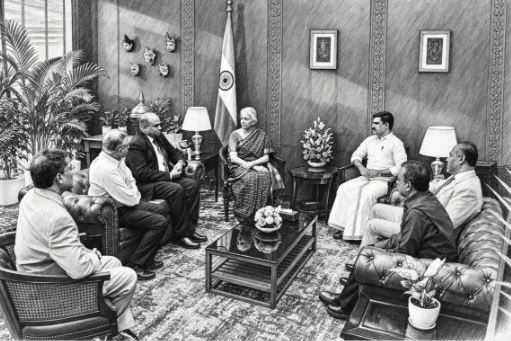
NEW YORK — November 1, 2026 — The US Tamil Diaspora expresses deep disappointment with the publicly reported presentation of Tamil concerns during the October 28 meeting with Indian Finance Minister Nirmala Sitharaman in New Delhi.
Engagement with senior Indian officials is valuable. However, the Tamil national question requires a full presentation of the Tamil people’s historical identity, traditional homeland, political aspirations and right to self-determination. Religious protection and economic assistance are necessary concerns, but cannot adequately address that question on their own.
Who participated, and whom did they represent?
Reported participants included Sri Lankan Tamil MPs Gajendrakumar Ponnambalam and Dr. Ilayathamby Srinath; Australian Tamil Congress president Krishnapillai Ilango and former president Manoharan Manickavinayagam; US Tamil organisation representative Lavan Muthu; and BJP national secretary M. Venkatesan.
Tamilwin credits Venkatesan with coordinating the meeting. Its report does not establish who first requested it, how diaspora participants were selected, or what authority their organisations gave them.
Elected MPs have authority arising from their electoral positions, and diaspora representatives may advocate within their organisational mandates. Participation in a meeting, however, does not establish authority to speak for all Tamils or the entire Tamil diaspora.
What was discussed?
Published accounts describe discussions concerning Tamil political rights, a political solution, protection of Thirukoneswaram temple, and the welfare of Sri Lankan Tamil refugees in Tamil Nadu. Sitharaman reportedly outlined India’s existing assistance and offered continued support.
According to Ponnambalam, he also raised concerns about threats to Tamil Hindu heritage at Kurunthurmalai, Veddukkunari, Thirukoneswaram and Kanniya, including whether Indian assistance could support activities harmful to Tamil identity.
What commitments were obtained?
Ponnambalam reported that Sitharaman assured the delegation that Indian funding would not be permitted to harm Tamil identity or Hindu religious heritage. He said she would raise these concerns with Prime Minister Narendra Modi and External Affairs Minister S. Jaishankar.
The cited coverage does not provide a written undertaking, implementation timetable or monitoring mechanism. These remain reported assurances whose practical effect must be demonstrated through follow-up action.
Tamil history and political aspirations require a complete presentation
The Tamil people’s case includes historic Tamil kingdoms and institutions of government, a traditional territorial homeland, a distinct language, culture and civilisation, and longstanding political aspirations.
The publicly available reports do not establish whether the delegation explained this historical and territorial foundation to the minister. That absence from the reporting does not prove the subjects were omitted from the meeting. It does require the delegation to clarify what was presented.
Was the 1977 mandate raised?
The delegation should state whether it discussed the 1977 electoral mandate associated with the Tamil United Liberation Front’s campaign for an independent Tamil Eelam, and explain how its present proposals relate to that mandate.
Ponnambalam reportedly reiterated that the 13th Amendment within a unitary constitutional framework would not meet Tamil aspirations and advocated federalism. The reporting does not clearly establish whether that precise position was presented inside the meeting or in subsequent comments. Nor does it identify an agreement by Sitharaman to support federalism or another specific political settlement.
Decolonisation and self-determination must be examined
The US Tamil Diaspora maintains that the Tamil national question must also be examined through international principles of decolonisation and the self-determination of peoples.
The United Nations Charter and General Assembly Resolutions 1514 (XV), 1541 (XV) and 2625 (XXV) provide important foundations for examining colonial domination, self-government and peoples’ freedom to determine their political status.
We call for an independent legal examination of their application to the Tamil people’s historical homeland, colonial experience and political aspirations. This is our advocated political and legal position. These instruments do not, by themselves, establish an automatic entitlement to a separate Tamil state; their application requires careful consideration of the relevant facts and international law.
The delegation should explain whether it raised these principles and how its proposed settlement would address them.
Tamil sovereignty must be central to the political demand
The US Tamil Diaspora calls upon Tamil representatives to seek the restoration of Tamil sovereignty through peaceful and democratic means, advancing their case under international principles of self-determination and decolonisation. We urge an independent legal assessment of how the UN Charter and relevant UN resolutions apply to this claim.
In our view, pursuing limited concessions without a clear path toward resolving the Tamil national question will not secure a lasting political settlement. Immediate protections and assistance remain necessary, but must accompany a sustained demand addressing the Tamil people’s homeland, collective rights and freely expressed political will.
We therefore call upon Tamil leaders to explain how every proposed settlement advances these objectives. Restoration of sovereignty is the political position we advocate; it must be supported by a rigorous legal case, rather than presented as an outcome automatically guaranteed by UN resolutions.
The delegation must provide a public account
We call upon the participants and organisers to publish:
1. The memorandum and written demands submitted to the minister.
2. The authority under which each diaspora participant attended.
3. The arguments presented concerning Tamil history, homeland and national rights.
4. Whether the 1977 mandate, sovereignty, self-determination and decolonisation were discussed.
5. The minister’s specific response concerning a political solution.
6. Any written commitments, responsible officials and agreed follow-up dates.
On the basis of the publicly reported presentation, the US Tamil Diaspora rejects it as an adequate expression of Tamil national aspirations. We remain open to assessing a fuller account supported by documents and evidence.
Tamil people deserve transparent representation, a complete presentation of their political case and measurable progress toward a future freely determined by them.
Thank you,
Tamil Diaspora News, USA
November 1, 2026