We have forwarded this press release to the following email addresses of the University Grants Commission (UGC) and the University of Jaffna:
info@ugc.ac.lk, chairman@ugc.ac.lk , secretary@ugc.ac.lk , info@univ.jfn.ac.lk , vc@univ.jfn.ac.lk , registrar@univ.jfn.ac.lk
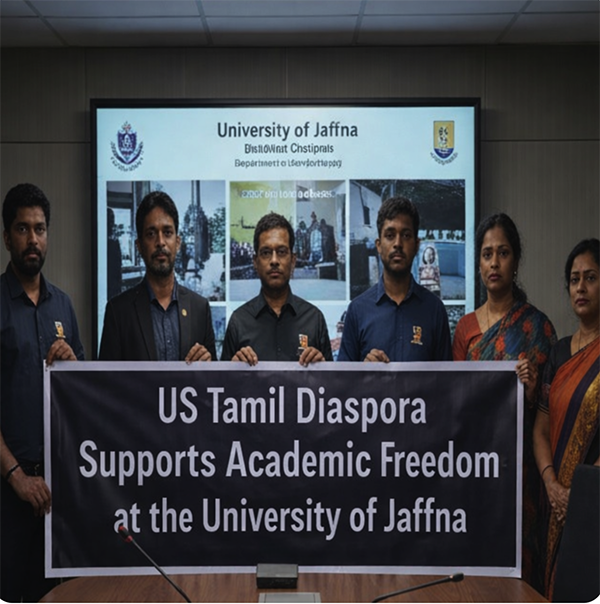
US Tamil Diaspora Condemns UGC Intimidation of Jaffna University Students
Date: February 18, 2026
The US Tamil Diaspora strongly condemns the actions of the University Grants Commission (UGC) in declaring the peaceful black flag protest at the University of Jaffna “unlawful” and calling for investigations and disciplinary measures against Tamil students.
On February 4, Tamil students, together with civil society groups and families of the disappeared, peacefully marked Sri Lanka’s Independence Day as a day of mourning. Black flags were raised across the North-East as a symbolic act of political remembrance — a practice observed by Tamils for decades.
The UGC’s move to criminalize this peaceful expression is an alarming act of political intimidation and a direct attack on academic freedom and democratic rights.
Peaceful Protest Is Not a Crime
There is no legitimate legal basis to classify the hoisting of black flags within a university campus as criminal conduct when no harm was caused to persons or property.
The UGC’s directive reflects an attempt to silence Tamil political expression rather than uphold any genuine legal principle.
Universities must remain spaces of intellectual freedom and democratic engagement — not instruments of nationalist suppression. When peaceful dissent is labeled unlawful, it exposes a dangerous double standard in the application of democratic values.
A Clear Double Standard
It is deeply contradictory for those who have benefited from mass protests and student-led political mobilization to now suppress Tamil students exercising peaceful democratic rights.
The black flag represents mourning, memory, and political conscience.
Suppressing Tamil students will not erase the historical grievances that led to such protests. Instead, it reinforces the perception of ongoing structural discrimination against the Tamil people.
The North-East Is the Tamil Homeland
The North-East of the island is the ancient homeland of the Tamil people. Tamil civilization, governance structures, and cultural continuity in this region predate colonial consolidation.
European colonial powers merged historically distinct Tamil and Sinhala territories in 1833 for administrative convenience. Upon independence, power was transferred to a Sinhala-majority state framework without adequate constitutional safeguards for the Tamil nation.
The present political imbalance is a consequence of that colonial restructuring.
We remind Sri Lankan authorities that the Tamil claim to the North-East is grounded in history, demography, and the internationally recognized principle of self-determination.
Disciplinary threats against students cannot erase historical reality.
Tamil Political Aspirations Remain
The US Tamil Diaspora affirms that Tamil political aspirations will continue to be pursued through lawful, democratic, and international mechanisms.
Intimidation within universities will not silence a people’s national consciousness.
Tamils remain committed to securing a just political settlement that acknowledges historical truths and respects their collective rights.
Call to Action
The US Tamil Diaspora calls upon:
- The University of Jaffna administration to resist politically motivated disciplinary action.
- Academic staff to defend institutional autonomy.
- International academic bodies and human rights organizations to monitor the situation.
- The Sri Lankan state to withdraw all threats against students.
A durable and peaceful future requires dialogue and acknowledgment — not repression.
Thank you,
Tamil Diaspora News,
February 19, 2026