Tamil Diaspora News: LSE Scholar’s Analysis Confirms Sri Lanka’s Majoritarian Democracy Helped Create Tamil Exclusion and Conflict
WASHINGTON, D.C. — Tamil Diaspora News states that the research paper “Democracy and Civil War in Sri Lanka” by José Luengo-Cabrera provides important scholarly support for the Tamil people’s long-standing argument: Sri Lanka’s post-independence political system did not protect Tamils, but instead allowed Sinhala-majority domination through a centralized Westminster-style democracy.
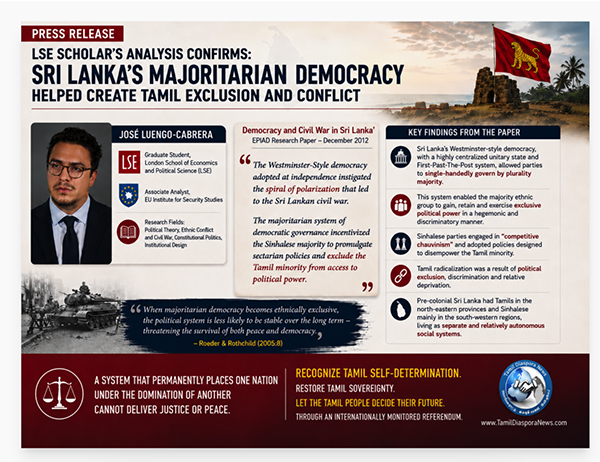
José Luengo-Cabrera is identified as a London School of Economics and Political Science graduate student and an Associate Analyst at the EU Institute for Security Studies. His paper examines Sri Lanka through the fields of political theory, ethnic conflict and civil war, constitutional politics, and institutional design.
Luengo-Cabrera writes that the “Westminster-Style democracy adopted at independence instigated the spiral of polarization that led to the Sri Lankan civil war.” He further states that the majoritarian system of democratic governance incentivized the Sinhalese majority to promote sectarian policies and “exclude the Tamil minority from access to political power.”
Tamil Diaspora News emphasizes that this research confirms what Tamils have argued for decades: in a deeply divided island, ordinary majority-rule democracy became a tool of permanent ethnic domination rather than a system of equality, justice, and coexistence.
The paper explains that Sri Lanka’s inherited Westminster-style democracy, combined with a highly centralized unitary state and First-Past-the-Post electoral system, created a destructive institutional structure. Luengo-Cabrera writes that this system allowed political parties to “single-handedly govern by plurality majority,” enabling the majority ethnic group to “gain, retain and exercise exclusive political power in a hegemonic and discriminatory manner.”
Tamil Diaspora News states that this analysis exposes the structural failure of Sri Lanka’s unitary state. The problem was not merely one leader, one party, or one period of violence. The problem was the political system itself: a system that rewarded Sinhala political parties for competing against each other through increasingly anti-Tamil policies.
Luengo-Cabrera also notes that Sinhalese parties engaged in “competitive chauvinism” and adopted policies designed to disempower the Tamil minority. The paper connects Tamil radicalization to political exclusion and relative deprivation.
Tamil Diaspora News further notes that the paper recognizes the historic territorial reality of the island. It states that in the pre-colonial era, Tamils and Sinhalese lived as separate and relatively autonomous social systems, with Tamils occupying the north-eastern provinces and Sinhalese mainly inhabiting the south-western regions.
This reinforces the Tamil position that Sri Lanka’s current centralized unitary state is a post-colonial construction that erased the historic political and territorial identity of the Tamil people. The Tamil homeland in the North and East cannot be permanently ruled through Sinhala-majority parliamentary power and then falsely described as democracy.
Tamil Diaspora News calls on the international community to recognize that Sri Lanka’s crisis cannot be solved by cosmetic reforms, empty reconciliation language, or another centralized constitution. A political system that permanently places one nation under the domination of another cannot deliver justice or peace.
The only honest path forward is to recognize the Tamil people’s right to self-determination, restore meaningful Tamil sovereignty, and allow the Tamil people to decide their political future through an internationally monitored referendum.
Tamil Diaspora News
www.TamilDiasporaNews.com
Thank you,
Tamil Diaspora News,
June03, 2026