Tamil Diaspora News | October 16, 2026
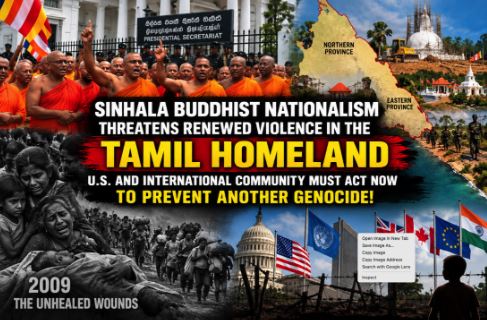
The recent demonstration by sections of Sri Lanka’s Sinhala Buddhist Maha Sangha outside the Presidential Secretariat raises renewed concerns about Sinhala Buddhist nationalism, state power, and the safety of Tamils and people belonging to other religions.
For decades, influential Sinhala Buddhist nationalist groups have promoted the belief that Sri Lanka is exclusively a Sinhala Buddhist country. This ideology has been invoked to justify Sinhala settlements, the appropriation of Tamil lands, and the construction of Buddhist temples on disputed sites in the traditional Tamil homeland of the Northern and Eastern Provinces.
The Tamil people fear that such religious nationalism could once again be used to incite ethnic violence, protect contested settlements, and intimidate Tamil communities resisting the loss of their ancestral lands.
This is not an objection to Buddhism or the freedom of Buddhists to practice their religion. It is an objection to the use of religious authority and state power to undermine the rights, land ownership, cultural heritage, and security of other communities.
The Trauma of 2009 Remains Unresolved
Tamil communities have not recovered from the devastation of the final stages of Sri Lanka’s civil war in 2009.
Tamil advocacy organizations have cited approximately 146,000 Tamils killed or unaccounted for, although this figure has not been independently established as a confirmed death toll. Thousands of families continue to seek answers about missing relatives, while survivors carry the psychological trauma of mass civilian suffering, displacement, and unresolved allegations of war crimes.
International governments that provided military, financial, or diplomatic assistance to Sri Lanka during the war must examine their responsibilities and the consequences of that support. Allegations of complicity require independent investigation, not silence.
The continuing militarization, contested land acquisitions, settlement policies, and construction of Buddhist religious structures in Tamil areas have intensified fears that the historical identity of the Tamil homeland is being systematically altered.
An Urgent Appeal to the United States and International Donor Countries
We call upon the United States, United Kingdom, Canada, India, European Union, United Nations, and all countries that supported Sri Lanka during the war to take immediate preventive action.
We specifically demand:
1. International protection for Tamils against renewed ethnic violence, intimidation, and the risk of mass atrocities.
2. An immediate halt to coercive land appropriation, forced demographic changes, and unauthorized Buddhist temple construction on disputed Tamil lands.
3. Independent international monitoring of human rights conditions throughout the Northern and Eastern Provinces.
4. International accountability for wartime atrocities, enforced disappearances, and credible allegations of state-supported abuses.
5. Human rights conditions on international aid and military assistance, with safeguards to prevent support from facilitating abuses.
Prevent Another Genocide — Do Not Wait Until It Happens
The Tamil people should not have to experience another catastrophe before the international community recognizes the danger.
Religious freedom cannot become a justification for territorial domination. Sinhala Buddhist religious leaders and the Sri Lankan government must reject ethnic incitement and respect the equal rights of Tamils and people belonging to other religions.
The United States and other international donor countries have a responsibility to examine the legacy of their wartime assistance and ensure that future support does not contribute to further suffering.
The warning signs must be addressed before violence begins — not after thousands of innocent civilians have lost their lives.
Protect the Tamil people. Protect their ancestral homeland. Prevent another genocide.
Tamil Diaspora News