
New Anti-Terrorism Bill Raises Concerns of Expanded Powers Despite Replacing the 47-Year-Old PTA
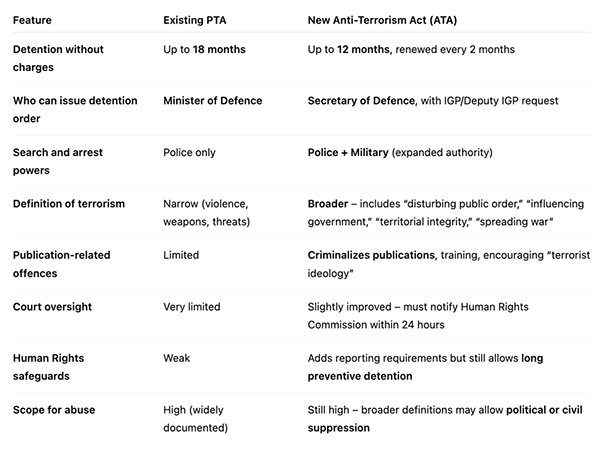

The Sri Lankan government has introduced a new Anti-Terrorism Act (ATA) to replace the longstanding Prevention of Terrorism Act (PTA), in force since 1979. While the new legislation is presented as a reform measure, a detailed comparison shows that several provisions expand state powers, raising concerns among legal observers, civil society organizations, and human-rights analysts.
The proposed ATA reduces preventive detention from 18 months under the PTA to 12 months, but maintains the ability to hold individuals without formal charges for extended periods. Under the new bill, the Secretary of Defence may issue renewable two-month detention orders on the recommendation of the IGP or Deputy IGP.
A key change in the ATA is its broadened definition of terrorism, which now includes acts that “influence the Government,” “disturb public order,” “spread war,” or “threaten territorial integrity.” Analysts warn that this expanded scope may allow for the inclusion of political activity, civil movements, online expression, or community advocacy under the category of “terrorism.”
Another significant shift is the extension of search and seizure powers to military personnel, who may stop individuals and confiscate items based on “reasonable suspicion.” Under the PTA, only police officers held such authority.
The proposed law also introduces penalties of up to 15 years imprisonment and fines of 15 million rupees for individuals linked to “terrorist publications,” training, or dissemination of material. Commentators note that the inclusion of media, digital content, and ideological material may raise concerns regarding freedom of expression.
While the ATA requires authorities to notify the Human Rights Commission of Sri Lanka and the Inspector General of Police within 24 hours of an arrest—a procedural improvement over the PTA—critics emphasize that prolonged detention without trial remains a central issue.
A spokesperson for civil society monitoring groups stated:
“Replacing the PTA is a long-standing demand, but meaningful reform requires reducing extraordinary powers, not reintroducing them under broader definitions. Any anti-terrorism law must comply with international human-rights standards and ensure safeguards against misuse.”
Analysts urge transparent consultation, independent review, and alignment with global legal norms to ensure that national security measures do not undermine civil liberties, minority rights, or democratic participation.
Thank you,
Tamil Diaspora News,
December 14, 2025