
The Mahavamsa is a myth, not historical fact. If its lion-ancestry story were literally true, every Sinhalese person would have a lion’s tail.
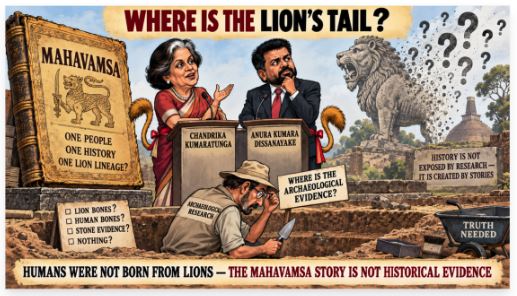
Exposing the Myths: The Mahavamsa Is a Religious Narrative, Not Archaeological Fact
The widespread manipulation of Sri Lankan history relies heavily on treating the Mahavamsa as a literal, undisputed record of archaeological truth.
For centuries, political and religious factions have weaponized the epic stories of Prince Vijaya, King Elara, and Dutthagamani to construct exclusive nationalist narratives. However, repeating these fabricated lineages for generations does not transform religious mythology into historical fact.
The claim that the Mahavamsa serves as an objective, contemporary historical blueprint is a complete falsehood. The chronicle was composed by Buddhist monks roughly one thousand years after the supposed arrival of Vijaya. It was intentionally written as a Pali Buddhist epic and a theological tool to legitimize specific religious lineages—not as an accurate historical document.
Even UNESCO’s official documentation explicitly classifies it as an epic poem initiated by the monk Mahanama in the fifth century CE, rather than a verified historical text.
Furthermore, the foundational myth of Prince Vijaya arriving with 700 followers is entirely unsupported by physical evidence. No contemporary inscription, monument, or archaeological artifact records Vijaya’s arrival. Presenting this migration story as an established archaeological reality is an outright distortion.
Academic scholarship, including research published by Oxford Academic, clearly treats the Vijaya narrative as an origin myth, exposing the dishonesty of using it to assert biological or territorial dominance.
Perhaps the most absurd historical lie is the literal interpretation of the Sinhala origin story, which claims ancestral descent from a literal lion. Human beings cannot biologically descend from non-human apex predators. To present this purely symbolic totem as genealogical science is a absolute deception.
If this narrative were rooted in biological reality, modern Sinhalese political figures—such as Chandrika Kumaratunga and Anura Kumara Dissanayake—would exhibit distinct feline genetic traits. They do not. The lion story is a mythological allegory, and passing it off as literal genealogy is an intentional manipulation of the public.
This systematic deception extends to the accounts of Elara and Dutthagamani. While these stories may loosely preserve the memory of ancient regional rulers, the hyper-detailed, dramatic battles recorded in the Mahavamsa were written centuries after the fact.
Not a single contemporary inscription independently verifies the epic duel or the political motivations exactly as the chronicle presents them.
Obfuscating the complete lack of corroborating archaeological evidence to maintain a politically convenient narrative is a direct assault on genuine historical science. The Mahavamsa functions as a brilliant piece of religious literature, but using it to overwrite objective archaeology is a demonstrable lie.