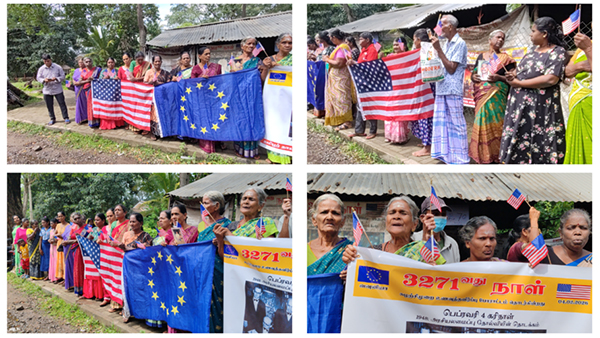
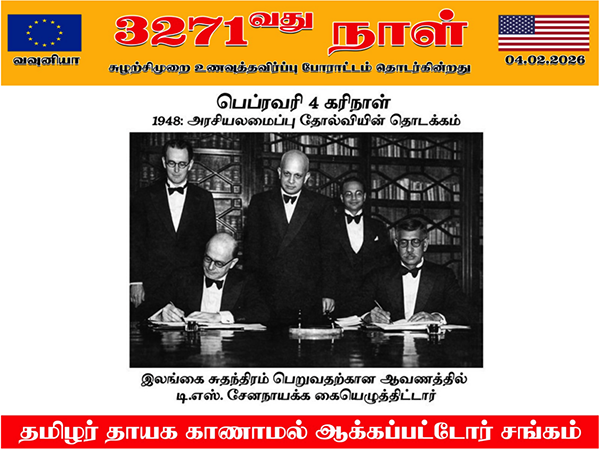
On Sri Lanka’s Independence Day, the Mothers of the Disappeared mark the day as Kari Naal (Black Day).
From a protest shed in Vavuniya, where they have been seated for 3,271 days, the mothers speak not as politicians or lawyers, but as parents whose children were taken and never returned.
This statement reflects on how the 1948 independence and the Soulbury Constitution, shaped during Britain’s hurried exit, failed to protect Tamil rights, lands, language, and lives—laying the constitutional foundation for decades of injustice and enforced disappearances.
For these mothers, Independence Day is not a celebration, but a reminder that true freedom will come only when the truth about their missing children is revealed and justice is delivered.
— Tamil Diaspora News
Black Day: A Constitutional Failure at the End of Colonial Rule
Today, the Sri Lankan government celebrates this day as Independence Day.
We — the mothers of disappeared Tamil children —
remember this day as Black Day.
The independence granted in 1948
did not bring freedom to us.
Instead, it became the beginning
of a long, dark path
in which our children were disappeared.
We are not politicians.
We are not legal experts.
We are mothers.
We are the ones who gave birth to our children.
Who raised them.
Who lost them.
Today, in the city of Vavuniya,
in this protest shed,
for 3,271 days,
we have been sitting here.
In rain and in heat,
as governments change,
as promises change,
our question alone has not changed.
In 1948,
Sri Lanka
gained independence.
But that independence:
- did not protect our rights
- did not respect our language
- did not safeguard our lands
- did not return our children to us
The roots of this injustice
lie within the constitution
created by the Soulbury Commission.
Britain,
in its hurried departure from Sri Lanka,
democratized majority rule
and left Tamils without protection.
Before colonial rule,
Tamils had:
- their own political authority
- their own land and administration
This truth was not stated in the constitution.
An unstated truth later became
a legalized injustice
that enabled the disappearance of our children.
The truth must be told.
Tamil political leadership also failed
to firmly demand
alternative constitutional safeguards.
It is the price of those failures
that we are paying today,
with our tears,
in this shed.
Our question is simple:
Where are our children?
Where are they?
Who is responsible?
When will there be justice?
Black Day is not a ceremonial day for us.
It is a reminder.
The day we attain freedom
will be the day
the truth about our children is revealed.
This is not Independence Day —
this is the Black Day on which our children were disappeared.
Thank you
K. Rajkumar
Association of Relatives of the Enforced Disappeared in the Tamil Homeland