Professor Jonathan Goodhand, Professor of Conflict and Development Studies at the School of Oriental and African Studies, University of London, examined Sri Lanka’s post-war political situation in his article:
“Sri Lanka in 2012: Securing the State, Enforcing the ‘Peace’”
The article was published in Asian Survey in 2013.
Professor Goodhand correctly identifies several serious realities facing the Tamil people. He explains that, after the end of the war in 2009, the Sri Lankan government continued to strengthen the unitary state, centralize political power, suppress opposition, weaken provincial institutions and resist a meaningful political settlement with the Tamils.
He also recognizes that the government promoted economic development in the North and East while avoiding meaningful political devolution. He notes that the government refused to clarify what powers it was prepared to devolve, despite assurances that it would implement or go beyond the 13th Amendment.
Professor Goodhand further describes the continuing militarization of the Tamil homeland, military interference in civilian administration, the appointment of Sinhala officials, the renaming of Tamil places, the erection of Sinhala signboards, military monuments and Buddha statues, and what he calls “creeping Sinhalization.”
These observations are important. However, the proposed political direction remains limited.
Professor Goodhand appears to place hope in devolution, provincial powers, implementation of the 13th Amendment, international pressure, accountability and reform within a united Sri Lankan state. His article does not present restoration of Tamil sovereignty as a possible political solution. Instead, it remains within the constitutional framework created by the centralized Sri Lankan state.
This is where we respectfully disagree.
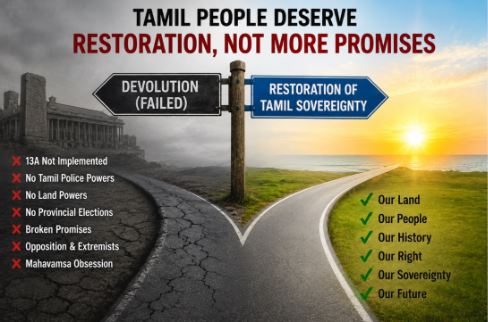
The Failure of Devolution
The history of Sri Lanka demonstrates that meaningful devolution has repeatedly been promised but not implemented.
The 13th Amendment was introduced in 1987, but the Tamil provinces were never given effective control over land, policing or security. Even Provincial Council elections have been delayed for years. The Northern Provincial Council has often existed without the powers necessary to protect Tamil land, institutions or political authority.
Successive Sinhala-led governments have made promises to India, the United Nations and the international community, but those promises have not produced meaningful autonomy.
Whenever one government discusses devolution, the opposition mobilizes against it. Sinhala-Buddhist nationalist organizations and sections of the Buddhist clergy frequently condemn even limited power-sharing as a betrayal of the unitary state. Governments then abandon agreements to avoid losing Sinhala electoral support.
Even a government holding a strong parliamentary majority may hesitate to implement devolution because it fears resistance from Sinhala nationalist forces, the opposition and influential Buddhist institutions.
Therefore, the problem is not simply the absence of another constitutional proposal. The deeper problem is that the Sinhala-dominated unitary state has repeatedly demonstrated that it is unwilling to transfer meaningful political authority to the Tamil people.
Academics Must Look Beyond 1948
It is deeply disappointing that many highly respected academics begin their analysis with independence in 1948, the civil war, the 13th Amendment or post-war reconciliation.
They often fail to examine what existed before European colonization.
The Tamil political question did not begin in 1948. It cannot be understood only through post-independence constitutional arrangements. Scholars must examine the political status of the Tamil and Sinhala peoples before Portuguese, Dutch and British colonial intervention.
British rule centralized the island under a single colonial administration. At independence, that colonial structure was transferred without restoring the political sovereignty that Tamil advocates argue had existed before colonial consolidation.
Yet many academic discussions continue to treat the modern unitary state as permanent, natural and unquestionable.
The Forgotten Question of Decolonization
The international community developed decolonization principles because colonial administrative boundaries did not always reflect the political rights, consent or sovereignty of the peoples placed inside them.
United Nations decolonization principles, including the right of peoples to self-determination, should therefore be part of any serious academic examination of Sri Lanka’s constitutional future.
Professor Goodhand’s article discusses international pressure, accountability and political reform. However, it does not examine whether the Tamil question should also be understood as an unfinished decolonization issue.
That omission is significant.
When decades of devolution, reconciliation, provincial councils, constitutional negotiations and political compromises have failed, scholars must be willing to ask a more fundamental question:
Why must the Tamil people permanently live under a Sinhala-dominated unitary state created through colonial consolidation?
The Tamil people should not be required to endlessly request limited powers from a central government that has repeatedly refused to recognize their political authority.
The issue is no longer only how much power Colombo should devolve.
The real issue is whether the sovereignty lost through colonial rule should be restored through peaceful, democratic and internationally supervised means.
Restoration, Not Another Broken Promise
Professor Goodhand accurately documented centralization, militarization, Sinhalization and the failure of the Sri Lankan government to reach a political settlement.
But those very findings should lead scholars to reconsider whether devolution remains a credible solution.
After decades of broken agreements and unimplemented constitutional promises, the Tamil political struggle cannot remain trapped within the same failed framework.
Academics should study:
▪ the pre-colonial political status of the Tamil people;
▪ the effects of Portuguese, Dutch and British colonial rule;
▪ the British consolidation of the island;
▪ the democratic mandate expressed by Tamil voters;
▪ international principles of self-determination and decolonization;
▪ and peaceful mechanisms for restoring Tamil sovereignty.
It is regrettable that so many distinguished scholars recognize the failure of the Sri Lankan state but still hesitate to examine the political framework that created and sustained that failure.
The time has come to move beyond another promise of devolution.
The lasting solution is the peaceful and democratic restoration of the sovereignty of the Tamil and Sinhala peoples.
Thank you,
Tamil Diaspora News,
August 3, 2026