
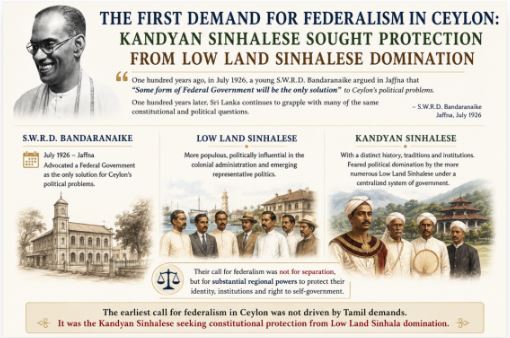
Federalism in Ceylon Began with Kandyan Fears of Low Country Sinhala Political Domination
One hundred years ago, in July 1926, a young S. W. R. D. Bandaranaike argued in Jaffna that “some form of Federal Government will be the only solution” to Ceylon’s political problems. One hundred years later, Sri Lanka continues to grapple with many of the same constitutional and political questions.
For decades, federalism has often been portrayed as a “Tamil demand.” History tells a different story.
The first prominent constitutional call for federalism in Ceylon came from S. W. R. D. Bandaranaike, who declared in Jaffna in July 1926 that “some form of Federal Government will be the only solution.” This was decades before the modern Tamil demand for federalism became a central political issue.
Why did Bandaranaike advocate federalism?
The answer lies within the Sinhala community itself.
The Kandyan Sinhalese, whose independent kingdom survived until the British annexation in 1815, feared that a centralized government would permanently place them under the political dominance of the more populous Low Country (Lowland) Sinhalese. They sought constitutional guarantees that would preserve their regional identity, institutions, and ability to govern their own affairs.
Their vision of federalism was not a symbolic or weak form of devolution. It was based on the principle that historically distinct regions should possess substantial constitutional powers, leaving only limited national responsibilities to the central government. This was a far more meaningful distribution of power than the limited provincial arrangements introduced decades later.
This historical fact exposes an important contradiction.
When federalism was proposed to protect the political interests of the Kandyan Sinhalese, it was presented as a practical constitutional solution. Yet when Tamils later sought constitutional arrangements to protect their own historic homeland and political rights, federalism was increasingly portrayed as a threat to national unity.
History should not be rewritten to fit contemporary politics.
Federalism did not originate as a Tamil political demand. It originated as a constitutional solution advanced by Sinhala leaders to address concerns within the Sinhala community itself. Recognizing this history is essential to any honest discussion about Sri Lanka’s constitutional evolution.
Historical facts matter. They remind us that federalism has long been regarded by many political thinkers as one possible method of accommodating regional diversity within a united state. Understanding where that idea first emerged in Ceylon is an important part of understanding the country’s constitutional history.
If you’re aiming this at a political audience, you could also add quotations from the 1926 Jaffna speech and contemporaneous Kandyan constitutional proposals to further strengthen the historical basis of the argument.
Thank you,
Tamil Diaspora News,
July 23, 2026