We Welcome the Chennai Outreach, but It Should Also Respect Jayalalithaa’s Position on Tamil Eelam and an Independence Referendum
We welcome the visit by Gajendrakumar Ponnambalam and his delegation to Chennai to meet with Tamil Nadu political leaders. It is important to keep the aspirations and struggles of the Tamil people in the North and East of Sri Lanka before the political leadership and people of Tamil Nadu. Such engagement helps maintain awareness and solidarity.
However, we are concerned that the political position advocated by the delegation appears to depart from the legacy of the late Chief Minister J. Jayalalithaa regarding the Tamil national question.
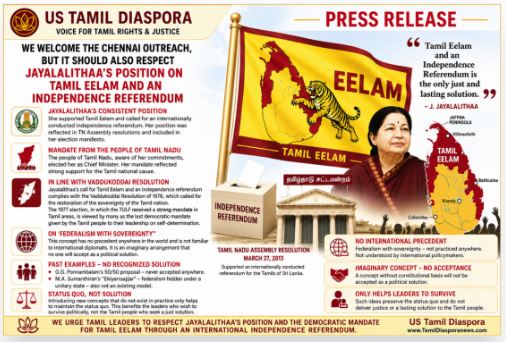
Jayalalithaa consistently expressed support for the Tamil people’s right to determine their political future. She publicly supported the establishment of Tamil Eelam and called for an internationally conducted independence referendum to enable the Tamil people to decide their own political future. Her position was reflected in resolutions adopted by the Tamil Nadu Legislative Assembly and was also included in her election manifesto.
The people of Tamil Nadu overwhelmingly elected Jayalalithaa as Chief Minister while being fully aware of these policy commitments. Her electoral mandate demonstrated that many voters supported her position on the Tamil national issue.
It is also important to recognize that Jayalalithaa’s position was consistent with the Vaddukoddai Resolution of 1976, which called for the restoration of the sovereignty of the Tamil nation through the establishment of an independent Tamil Eelam. Supporters of this position also point to the 1977 parliamentary election, in which the Tamil United Liberation Front (TULF) sought and received a strong electoral mandate in the Tamil-majority constituencies on that platform. From this perspective, the call for an independent Tamil Eelam remains the last democratic electoral mandate given by the Tamil people to their political leadership regarding their national political future. Jayalalithaa’s support for Tamil Eelam and an internationally conducted independence referendum therefore reflected and reaffirmed that democratic mandate.
We also question the proposal of “federalism with sovereignty” advanced by Gajendrakumar Ponnambalam. In our view, this is not a recognized constitutional or political model that has been implemented as a national political arrangement anywhere in the world. Because it is not an established constitutional framework, we believe it is unlikely to be readily understood or accepted by many international policymakers and diplomats, who are generally more familiar with constitutional models that have been implemented in practice.
From our perspective, proposing a political framework that has no established constitutional precedent makes it more difficult to build international support. We believe that any long-term political proposal should be based on concepts that are clearly defined in constitutional practice and international law.
This concern is not new. Historically, G.G. Ponnambalam’s proposal for 50-50 representation was also a unique constitutional proposal that was never adopted elsewhere as a political solution. Likewise, M.A. Sumanthiran has argued that meaningful federal principles can exist within the framework of an Ekiya Rajya (Unitary State). We believe these approaches likewise represent constitutional interpretations that remain the subject of political debate rather than established constitutional models with broad international recognition.
In our opinion, repeatedly advancing new constitutional concepts that lack clear international examples risks preserving the political status quo rather than moving toward a durable and achievable solution. We believe Tamil political leadership should advocate proposals that are clearly understood internationally, grounded in established legal and constitutional principles, and capable of attracting meaningful international support. Otherwise, there is a risk that proposing concepts without recognized constitutional precedent may inadvertently prolong the existing political situation rather than advance a lasting political settlement.
As Tamil political leaders engage with Tamil Nadu’s leadership today, we believe they should acknowledge and respect Jayalalithaa’s stated position on Tamil Eelam and an independence referendum, which many supporters view as being consistent with the democratic mandate expressed through the Vaddukoddai Resolution and the 1977 electoral mandate.
We encourage all political efforts that advance justice, accountability, and the democratic aspirations of the Tamil people while remaining faithful to principles that are clear, internationally understood, and grounded in democratic legitimacy.