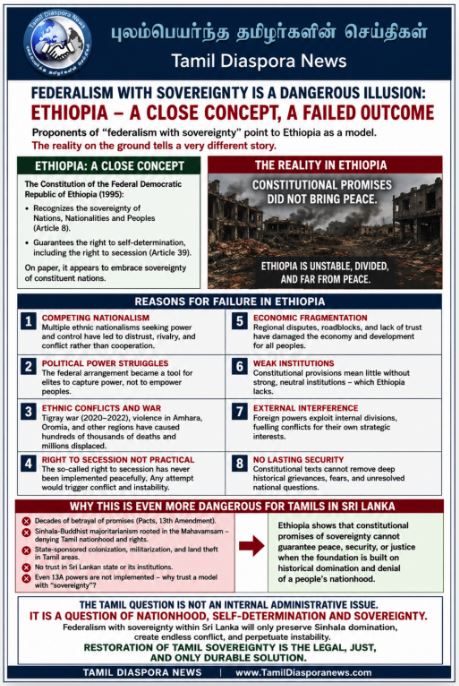
Federalism with sovereignty has failed to provide lasting peace even in its closest constitutional example, Ethiopia. Sri Lanka’s history of broken promises and Sinhala-Buddhist majoritarianism offers little basis for confidence in another constitutional experiment. The restoration of Tamil sovereignty remains the only durable and just solution.
#TamilSovereignty #TamilEelam #TamilSelfDetermination #RestoreTamilSovereignty #TamilReferendum #Decolonization #JusticeForTamils #TamilRights #SriLanka #EelamTamils #RightToSelfDetermination #TamilNation
X link: https://x.com/diaspora_tamil/status/2073068888070205535
Federalism with Sovereignty Is Not a Durable Solution for the Tamil Nation: Restoration of Tamil Sovereignty Remains the Only Viable Path
The recent promotion of “federalism with sovereignty” as a solution to the Tamil national question has once again raised fundamental concerns among many Eelam Tamils and members of the global Tamil diaspora.
Supporters of this model point to multinational constitutional arrangements such as Ethiopia. However, Ethiopia’s experience demonstrates the limitations and instability of attempting to manage competing national aspirations within a single state structure. Despite constitutional provisions recognizing the sovereignty of nations and peoples and even providing a right to secession, Ethiopia has experienced severe internal conflicts, including the devastating Tigray war and continuing regional instability. Constitutional language alone has not guaranteed peace, security, or durable coexistence.
The Tamil experience in Sri Lanka presents even greater challenges.
For more than seven decades, successive Sri Lankan governments have failed to honor agreements and constitutional promises made to the Tamil people. Agreements such as the Bandaranaike-Chelvanayakam Pact and the Dudley-Chelvanayakam Pact were abandoned under Sinhala nationalist pressure. The promises of devolution under the Thirteenth Amendment remain largely unimplemented, with meaningful powers over land, policing, and self-government continually denied.
Furthermore, Sinhala-Buddhist nationalism has been deeply influenced by historical narratives derived from the Mahavamsa, which presents the island as a sacred Sinhala-Buddhist homeland and has frequently been invoked to justify centralized state power and resistance to meaningful power-sharing. The repeated rejection of Tamil political demands, coupled with state-sponsored demographic changes, militarization, and continuing land appropriation in Tamil areas, has severely eroded confidence in any future constitutional arrangement within a unitary Sri Lankan state.
History demonstrates that constitutional formulas alone cannot overcome entrenched political realities. If even Ethiopia’s expansive constitutional protections have not prevented conflict, there is little basis to believe that a weaker and more fragile arrangement in Sri Lanka would provide lasting security for the Tamil nation.
The Tamil people historically possessed their own sovereignty, territory, and institutions before their incorporation into a single state under British colonial rule. The unresolved national question in the island therefore remains one of decolonization and the restoration of a people’s sovereignty.
Accordingly, many Tamils argue that the restoration of Tamil sovereignty through the exercise of the right to self-determination remains the only durable and legally grounded solution capable of ensuring security, dignity, and democratic self-government for the Tamil nation.
Only the restoration of Tamil sovereignty can provide a permanent and just resolution to the Tamil national question.
US Tamil Diaspora
Our Identity. Our Rights. Our Future.
July 03, 2026