Sri Lanka’s 6th Amendment Cannot Silence the Tamil Demand for Restored Sovereignty
Tamil Diaspora News
Washington, D.C.
Tamil Diaspora News states that Sri Lanka’s 6th Amendment must not be misused to confuse or silence the Tamil people’s demand for restored sovereignty.
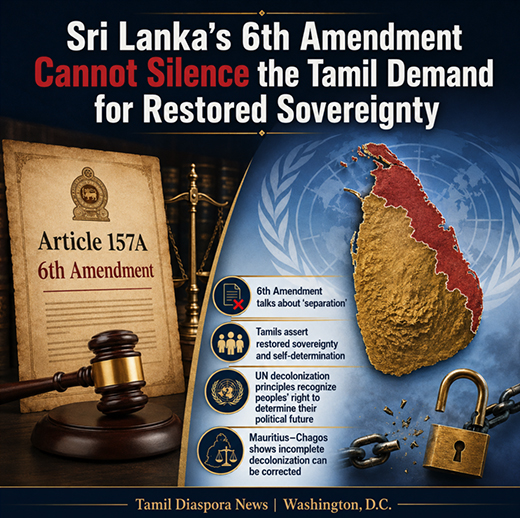
The 6th Amendment to Sri Lanka’s Constitution prohibits any person, political party, association, or organization from supporting, promoting, financing, encouraging, or advocating the establishment of a “separate State within the territory of Sri Lanka.” But the Tamil national question is not merely a question of “separation.” It is a question of restoring the sovereignty of a people whose historical homeland, political authority, and right to self-determination were absorbed through colonial rule and later denied under a Sinhala-majoritarian unitary state.
The Tamil demand for restored sovereignty is a lawful political demand under the principles of United Nations decolonization and self-determination. UN General Assembly Resolution 1514 and the International Covenant on Civil and Political Rights recognize that all peoples have the right to self-determination and may freely determine their political status.
Therefore, Sri Lanka cannot claim that Tamil sovereignty is illegal simply because its domestic constitution says so. A state cannot use its own constitution to permanently erase the political rights of a people, especially when that people’s homeland and sovereignty were affected by colonial rule and later denied through majoritarian domination.
The Mauritius–Chagos / Diego Garcia precedent shows that colonial-era territorial arrangements are not automatically final. The Chagos Archipelago was separated from Mauritius before independence. Decades later, the International Court of Justice stated that Mauritius’ decolonization had not been lawfully completed. The United Nations General Assembly then called for the end of British administration over Chagos. Later, the United Kingdom agreed to transfer sovereignty over the Chagos Archipelago to Mauritius, while keeping Diego Garcia under a military-base arrangement.
This precedent shows that incomplete decolonization can be corrected and sovereignty can be restored. If international law can recognize Mauritius’ right to restore sovereignty over Chagos, the world must also seriously examine the Tamil claim: that the Tamil homeland and Tamil sovereignty were absorbed under colonial rule and later trapped inside a Sinhala-majoritarian unitary state without the free consent of the Tamil people.
Tamil Diaspora News states clearly: Tamils do not need to beg Sri Lanka for permission to exist as a people. The world must recognize that Tamils, like other peoples affected by colonial arrangements, have the right to restore their sovereignty through democratic, peaceful, and internationally supervised means.
The 6th Amendment was created to protect the unitary Sinhala-dominated state. It does not answer the deeper question: How did the Tamil homeland, once governed under its own political traditions, become centralized under Colombo after colonial rule?
Sri Lanka’s domestic constitution cannot erase international principles of decolonization, self-determination, equality, and justice. The 6th Amendment violates the spirit of UN decolonization principles because it criminalizes peaceful advocacy for a people’s political future.
Tamil Diaspora News calls upon the United Nations, democratic governments, and human rights institutions to recognize this distinction:
The 6th Amendment talks about “separation.”
The Tamil demand is about restored sovereignty, self-determination, and justice.
The Mauritius–Chagos precedent shows that incomplete decolonization can be corrected and sovereignty can be restored.
Peace in the island will not come by criminalizing Tamil political aspirations. Peace will come only when the truth is accepted: Tamils are a people with a homeland, a history, and an undeniable right to self-determination.
Tamil Diaspora News urges the international community to support an internationally supervised referendum so the Tamil people can freely determine their future and restore their lost sovereignty through democratic means.
Contact:
Tamil Diaspora News
news@tamildiasporanews.com
www.tamildiasporanews.com
Supportive links
1. Sri Lanka 6th Amendment / Article 157A
This supports the point that the 6th Amendment talks about a “separate State within the territory of Sri Lanka.”
https://lankalaw.net/wp-content/uploads/2025/02/1983Y0V0C0A6S.html
Citation support: ([Lanka Law][1])
2. Sri Lanka Constitution PDF — Parliament of Sri Lanka
Official constitution PDF, including Article 157A / 6th Amendment text.
https://www.parliament.lk/files/pdf/constitution.pdf
Citation support: ([parliament.lk][2])
3. UN General Assembly Resolution 1514 — Declaration on Decolonization
This supports the argument that all peoples have the right to self-determination and may freely determine their political status.
https://www.ohchr.org/en/instruments-mechanisms/instruments/declaration-granting-independence-colonial-countries-and-peoples
Citation support: ([UN Human Rights Office][3])
4. International Covenant on Civil and Political Rights — Article 1
This supports the same self-determination principle: “All peoples have the right of self-determination.”
https://www.ohchr.org/en/instruments-mechanisms/instruments/international-covenant-civil-and-political-rights
Citation support: ([UN Human Rights Office][4])
5. International Covenant on Economic, Social and Cultural Rights — Article 1
Another UN treaty source recognizing the right of peoples to self-determination.
https://www.ohchr.org/en/instruments-mechanisms/instruments/international-covenant-economic-social-and-cultural-rights
Citation support: ([UN Human Rights Office][5])
6. ICJ Chagos / Mauritius Advisory Opinion page
This supports the Mauritius–Chagos precedent. The ICJ said Mauritius’ decolonization was not lawfully completed when Chagos was separated.
https://www.icj-cij.org/case/169
Citation support: ([International Court of Justice][6])
7. ICJ Advisory Opinion document — Chagos Archipelago
Direct ICJ advisory opinion page.
https://www.icj-cij.org/node/105778
Citation support: ([International Court of Justice][7])
8. UN General Assembly Resolution on Chagos Archipelago — A/RES/73/295
This supports the point that the UN General Assembly called for the UK to end its administration of Chagos.
https://digitallibrary.un.org/record/3806313/files/A_RES_73_295-EN.pdf
9. Reuters — UK agrees Chagos sovereignty deal with Mauritius
This supports the point that the UK agreed to transfer sovereignty of Chagos to Mauritius while keeping Diego Garcia under an arrangement.
https://www.reuters.com/world/britain-agrees-chagos-island-sovereignty-deal-with-mauritius-2024-10-03/
10. UN legal background on Resolution 1514
Useful for explaining that decolonization includes the right to freely determine political status.
https://legal.un.org/avl/ha/dicc/dicc.html
Citation support: ([United Nations Legal Affairs][8])