Tamil Diaspora: Horowitz’s Ethnic Power-Sharing Analysis Strengthens the Case for UN Decolonization and Tamil Self-Determination
WASHINGTON, D.C. — Tamil Diaspora states that Donald L. Horowitz’s analysis on ethnic power-sharing and democracy provides powerful academic support for the Tamil people’s long-standing argument: in a deeply divided island like Sri Lanka, ordinary majority-rule democracy has not protected Tamils but has enabled permanent Sinhala-majority domination.
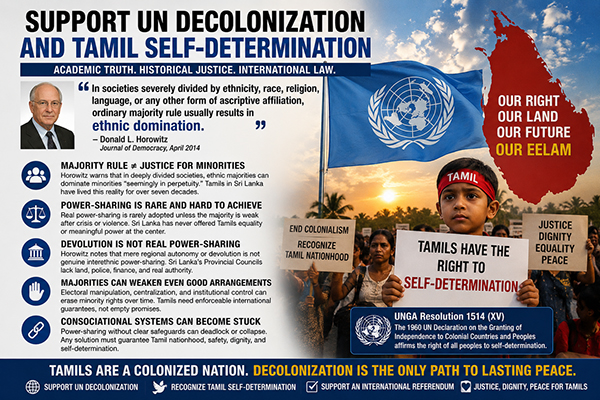
In his Journal of Democracy article, Horowitz explains that in societies deeply divided by ethnicity, language, religion, or race, ethnic parties and ethnic voting make democracy difficult, because an ethnic majority can dominate minorities “seemingly in perpetuity.” He further states that ordinary majority rule in such societies usually results in ethnic domination. This directly reflects the Tamil experience under Sri Lanka’s post-colonial unitary state.
For more than seven decades, Tamils have faced failed promises of devolution, broken pacts, militarization, land occupation, language discrimination, pogroms, and the 2009 Mullivaikkal genocide. The Provincial Council system has failed to provide real power over land, police, finance, security, or national decision-making. Horowitz’s article also notes that mere regional autonomy or territorial devolution is not the same as genuine interethnic power-sharing at the center.
Therefore, Tamil Diaspora argues that the Tamil question cannot be solved through cosmetic provincial elections or weak internal reforms controlled by Colombo. The root problem is colonial-era forced unity without Tamil consent. The proper legal and democratic path is to apply the 1960 UN Declaration on the Granting of Independence to Colonial Countries and Peoples, known as UN General Assembly Resolution 1514, and recognize the Tamil people’s right to self-determination.
The international community must understand that Sri Lanka is not simply a normal democracy with minority grievances. It is a deeply divided post-colonial state where majority rule has become ethnic-majority domination. When internal democracy fails to protect a people’s existence, homeland, dignity, and security, international law must provide a remedy.
Tamil Diaspora calls upon the United Nations, the United States, the European Union, India, Canada, the United Kingdom, Australia, and all democratic governments to support an internationally supervised referendum for Eelam Tamils in the North-East and the diaspora. The legal foundation for this process is the UN decolonization principle and the right of self-determination, while the referendum is the democratic mechanism through which the Tamil people can express their political will. Just as Mauritius used international law to challenge colonial injustice over Chagos, Tamils must be allowed to use international legal mechanisms to restore their sovereignty and secure lasting peace.
Only decolonization, self-determination, and democratic consent can bring justice and peace to the island.
Thank you,
Tamil DIaspora News,
May 27, 2026