Sinhala-Buddhist religious control over governance continues to marginalize Tamils, erode democracy, and destabilize the nation.
December 14, 2025
Sri Lanka once again stands at a dangerous crossroads. History has repeatedly shown that when Sinhala political leaders take direction not from democratic institutions but from Sinhala-Buddhist clergy, the country moves further away from justice, equality, and peaceful coexistence among its people.
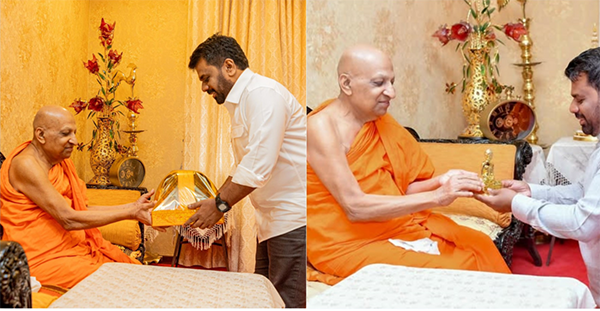
The recent public endorsement of the Anura Kumara–led government by the Malwathu and Asgiriya chief prelates is not a neutral religious gesture. It is a political signal—one that reinforces a long-standing pattern in Sri Lanka where state power is legitimized through religious authority, sidelining Hindus, Tamils, Christians, Muslims, and all other non-Buddhist religious communities.
This fusion of politics and clergy has never brought stability to Sri Lanka. Instead, it has contributed to decades of ethnic conflict, civil war, systemic exclusion, and the erosion of democratic norms. Whenever Sinhala leaders have governed under clerical blessing, Tamils and other religious communities have paid the heaviest price.
The Sinhala identity was constructed around the 6th century through intermixing among ancient Tamil Eelam peoples, Yakkar and Nagar communities, and North Indian sailors. This is historically a Tamil land, and a later, man-made Sinhala identity has no legitimacy to dominate, govern, or exercise control over the Tamil people.
The current humanitarian crisis caused by severe floods and landslides has once again exposed this structural imbalance. While international actors—including the United States, the United Nations, the IMF, and the Asian Development Bank—have stepped forward with financial and logistical assistance, internal political legitimacy is being sought through religious certification rather than accountability and transparency.
There is serious concern that disaster recovery and international funding may be used to advance long-term demographic and cultural projects, particularly in Tamil regions. Past experience shows that state institutions, including archaeology and conservation departments, have operated in ways that disadvantage Tamils and undermine Hindu and Tamil cultural heritage.
True recovery requires more than foreign aid and symbolic gestures. It requires a political culture that separates religion from state power, respects Hindu, Christian, Muslim, and Buddhist communities equally, and guarantees the dignity and rights of the Tamil people.
We, the Tamil people, have the inherent right to our traditional lands and the right to live in peace with our own people. No recently constructed ethnic or political identity has the moral or legal authority to manipulate, dominate, or control the Tamil nation. Coexistence is possible only through mutual respect, not subjugation.
If there is still hope for a different future, the image of political leaders seeking legitimacy under clerical authority should serve as a warning. Sri Lanka cannot move forward by repeating the patterns that led to division and suffering.
Democracy cannot survive under religious command.
Peace cannot exist without religious equality.
Sri Lanka cannot heal without recognizing the Tamil people’s right to live freely on their land.