
March 15, 2026
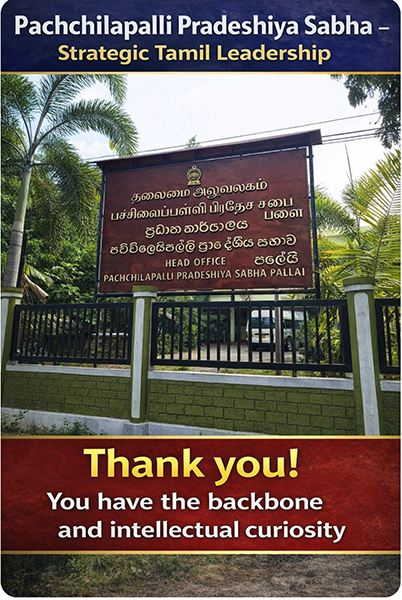
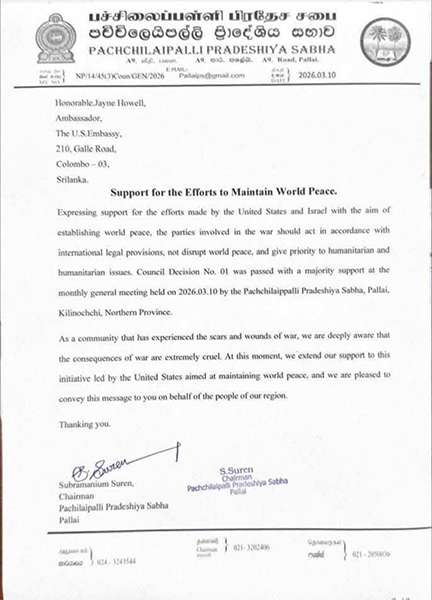
The US Tamil Diaspora welcomes and commends the resolution reportedly passed by the Pachchilapalli Pradeshiya Sabha (பச்சிளைப்பள்ளி பிரதேச சபை) praising the governments of the United States and Israel in relation to the Gulf conflict (வளைகுடா யுத்தம்) and recognizing the role of democratic powers in maintaining global stability. It is important to remember that Iran is governed by a religious clerical system, and many analysts describe its politics as strongly shaped by religious authority. The US Tamil Diaspora notes that this situation is comparable to how religious nationalist forces have influenced politics in Sri Lanka, where Buddhist nationalist movements and clergy have historically exerted significant influence over political decisions and minority rights debates.
At a time when many Tamil political actors remain hesitant to engage openly with global geopolitical realities, the Tamil representatives associated with this resolution have demonstrated strategic clarity and political courage. Their willingness to acknowledge the role of the United States reflects an understanding that the Tamil national issue must be addressed within the framework of international law and global diplomacy.
For decades, the Tamil people have faced oppression, broken promises, and the denial of their political rights. The Tamil nation possessed its own sovereignty and political structures before colonial powers merged separate territories into what later became Sri Lanka. The US Tamil Diaspora therefore believes that the path to justice lies within international legal principles.
One such principle is the 1960 United Nations Declaration on Decolonization, which affirmed the right of peoples under colonial arrangements to restore their political status and exercise self-determination.
The US Tamil Diaspora believes that if the international community—particularly the United States as a leading global power—supports the implementation of the 1960 UN decolonization principles, it would be possible to restore the sovereignty that the Tamil nation possessed before colonization.
Those who supported or spoke in favor of the Pachchilapalli resolution show that they understand the importance of connecting the Tamil national question with international law, global diplomacy, and democratic alliances.
In contrast, those who remain silent on these realities demonstrate a troubling lack of intellectual curiosity and strategic vision. Silence cannot secure the political future of the Tamil nation.
History will remember those who had the courage to think strategically — both here in the United States and in the homeland of Tamil Eelam.