
2026–2027 Panchangam Appears to Foretell Himalayan Ice Melt — A Remarkably Close Prediction
August 31, 2026
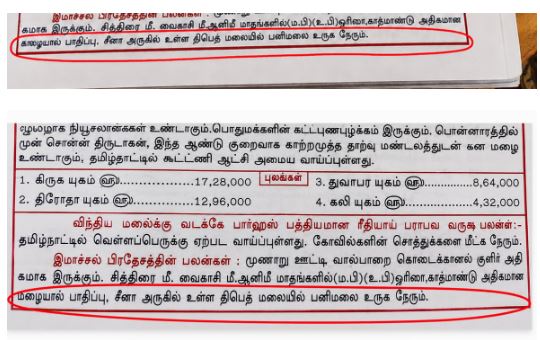
A striking passage contained in the 2026–2027 Parabhava Year Panchangam has attracted attention following the recent flooding in the Nepal–Tibet Himalayan region.
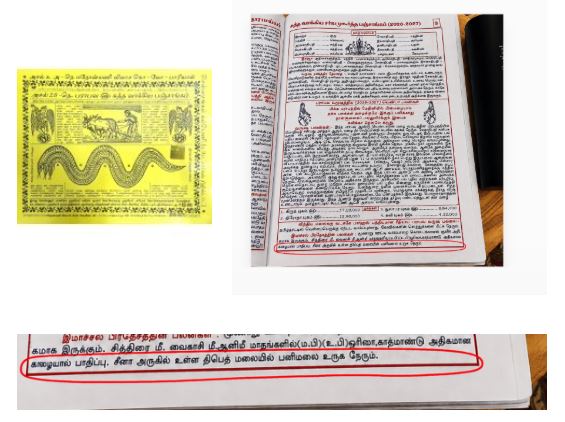
On page 3, the Panchangam contains annual forecasts concerning northern India and the Himalayan region. Among the predictions are references to heavy rainfall, conditions affecting northern regions, and the melting of ice or snow in the Tibetan mountain region near China.
Following the recent destructive flooding in the broader Nepal–Tibet Himalayan region, the similarity between the previously published Panchangam passage and the subsequent natural event appears remarkably close and deserves examination.
How could the Panchangam have calculated this?
Traditional Vakkiya Panchangam calculations combine astronomical calendar calculations with astrological interpretation.
The Panchangam first calculates factors including the movements and positions of the Sun, Moon and traditional planets; Tithi (lunar day); Nakshatra (lunar mansion); Yoga and Karana; planetary transits; and the traditional planetary rulers assigned to a particular year.
Traditional astrological rules are then applied to these configurations. Certain combinations are historically associated with rainfall, drought, floods, unusual heat, snow or ice conditions, agricultural production and disturbances affecting particular geographical directions or regions.
In simplified form:
Astronomical positions → Panchangam calculations → traditional planetary rules → geographical/directional interpretation → annual prediction
A remarkably specific similarity
What makes this case particularly interesting is that the Panchangam does not appear merely to make a broad statement such as “there will be a natural disaster.”
The passage reportedly identifies the Himalayan/Tibetan mountain region and refers specifically to ice or snow melting. When this is compared with the subsequent flooding affecting the broader Himalayan border region, the similarity is striking.
The important question therefore becomes:
How did the authors of a Panchangam published before the event arrive at such a geographically and environmentally specific forecast?
That question deserves serious historical and scholarly investigation into the computational and interpretive methods used in traditional Tamil Panchangam astronomy and astrology.
At the same time, the similarity should not be presented as scientific proof that astrology can predict natural disasters. Modern science has not established Panchangam astrology as a reliable method for predicting the timing or location of floods, earthquakes, or glacial disasters.
Nevertheless, when a prediction can be shown to have been printed before an event and its original wording closely resembles what subsequently occurred, the correspondence itself is remarkable and worthy of careful study.
Source: 2026–2027 Parabhava Year Panchangam, Page 3.