Tamil Version: https://gem.godaddy.com/p/0157ed1
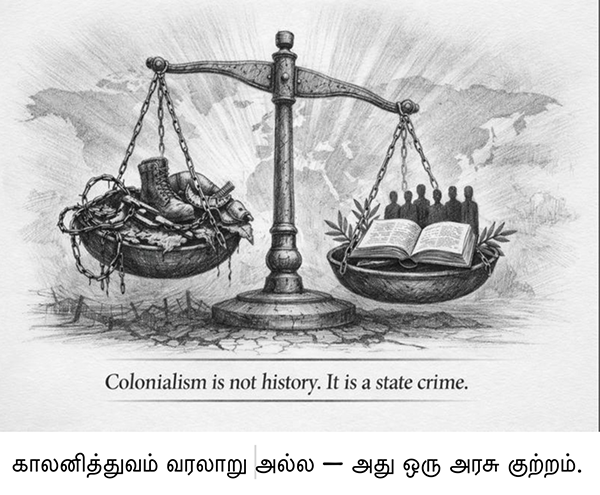
Algeria’s Declaration of Colonialism as a State Crime Sets a Legal Precedent Relevant to Tamils in Sri Lanka
December 25, 2025 — International
The recent passage of a landmark law by Algeria’s Parliament declaring French colonialism a “state crime” has renewed global attention on the legal responsibility of states for colonial-era atrocities. The Algerian law, adopted unanimously, formally recognizes colonialism as a crime committed by the state, demands an official apology, and affirms the right of the Algerian people to full material and moral reparations for the suffering inflicted during colonial rule.
This development carries direct relevance for other peoples subjected to state-sponsored colonization and mass violations of human rights, including the Tamils of Sri Lanka.
Algeria’s legislation identifies crimes such as extrajudicial killings, physical and psychological torture, systematic resource plunder, and long-term harm caused by nuclear testing as consequences of colonial governance. Crucially, the law asserts that colonialism is not merely a historical episode but a prosecutable state crime with enduring legal and moral consequences. It further emphasizes that national memory cannot be erased, bargained away, or subordinated to political convenience.
For Tamils in Sri Lanka, this framework resonates powerfully. While Algeria’s experience involved external European colonialism, international law does not limit colonial crimes to overseas empires. State-engineered internal colonization—where a people are dispossessed of their land, denied self-determination, subjected to demographic manipulation, and exposed to mass violence—falls squarely within the same legal logic.
In Sri Lanka, Tamils have endured decades of state-driven policies that mirror colonial practices: militarized land seizures, forced demographic change, cultural and religious erasure, enforced disappearances, mass civilian killings, and systematic economic marginalization. These acts are not relics of a distant past; many continue today, making the Tamil case particularly urgent under international law.
Algeria’s assertion that full and just reparations are an “inalienable right” aligns with established international legal principles, including the UN Charter, the International Covenant on Civil and Political Rights, the Genocide Convention, and the UN Basic Principles on the Right to a Remedy and Reparation. These frameworks affirm that victims of grave violations are entitled not only to acknowledgment and apology, but also to restitution, compensation, rehabilitation, and guarantees of non-repetition.
The Algerian law also challenges the increasingly common practice of promoting “reconciliation” without truth or accountability. As Algeria’s Parliament made clear, reconciliation cannot be imposed while historical crimes remain denied or minimized. This message is directly applicable to Sri Lanka, where calls for reconciliation continue alongside denial of genocide, suppression of memory, and the imposition of dominant historical narratives in Tamil regions.
Algeria’s action reinforces a growing international consensus: colonialism, whether external or internal, constitutes a state crime with lasting legal consequences. For Tamils, it strengthens the legitimacy of demands for truth, reparations, and the restoration of political and territorial rights rooted in the principle of self-determination.
The precedent set by Algeria underscores a simple but profound truth: justice delayed does not erase responsibility, and history cannot be rewritten to absolve state crimes.
Legal Bottom Line
Under binding international law, state-imposed colonization, demographic engineering, cultural destruction, and mass violence constitute crimes that trigger obligations of accountability, reparation, and non-repetition.
Whether carried out by a foreign colonial power or through internal state mechanisms, such acts violate the right of peoples to self-determination and amount to crimes against humanity and, where intent is established, genocide.
Accordingly, the Tamil people possess an internationally recognized legal right to truth, restitution, compensation, rehabilitation, and guarantees of non-recurrence, as well as the right to pursue political and territorial self-determination free from coercion or imposed historical narratives.
UN & International Legal References
- UN Charter, Article 1(2) — Right of peoples to self-determination
- International Covenant on Civil and Political Rights (ICCPR), Articles 1, 2, 7, 18, and 27
- International Covenant on Economic, Social and Cultural Rights (ICESCR), Article 1
- Convention on the Prevention and Punishment of the Crime of Genocide, Articles I–III
- UN Declaration on the Rights of Indigenous Peoples (UNDRIP), Articles 3, 8, 11, 12, and 26
- UN Basic Principles and Guidelines on the Right to a Remedy and Reparation (UN General Assembly Resolution 60/147, 2005)
- Rome Statute of the International Criminal Court, Articles 7 and 8
- UN General Assembly Resolution 1514 (XV) — Declaration on the Granting of Independence to Colonial Countries and Peoples
- UN General Assembly Resolution 2625 (XXV) — Friendly Relations and Self-Determination of Peoples
- UN General Assembly Resolution 2625 (XXV) — Friendly Relations and Self-Determination of Peoples
Al Jazeera: Algeria declares France’s colonial rule a crime in new law — details the law’s contents and political symbolism. ([Al Jazeera][2])
https://www.aljazeera.com/news/2025/12/24/algeria-declares-frances-colonial-rule-a-crime-in-new-law
Thank you,
Tamil Diaspora News,
Deceber 25, 20205