
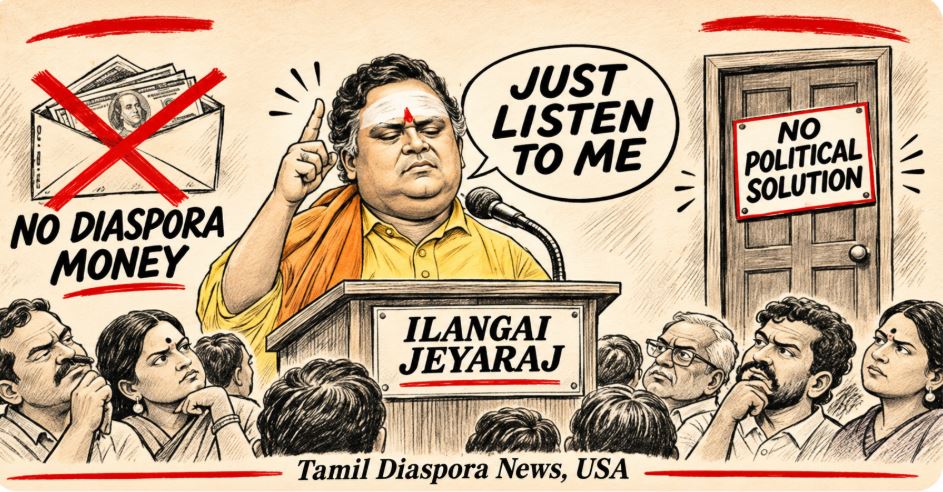
NEW YORK, NY — Tamil Diaspora News, USA, condemns Tamil literary and religious speaker Kambavarithi Ilangai Jeyaraj’s reported call for Tamils to forget their past struggles. It also rejects his claim that Tamil society would regain its former balance if money from overseas Tamils stopped reaching the homeland. Both proposals would deepen the conditions that leave Tamils facing second-class treatment in Sri Lanka.
According to IBC Tamil’s November 6 report, Jeyaraj urged Tamils to forget past struggles and argued that Tamil society would improve if money from the diaspora stopped flowing to the homeland. Tamil Diaspora News calls on him to release the full speech so the public can hear his remarks in context.
“Asking Tamils to forget their freedom struggle is an insult to S. J. V. Chelvanayakam and to generations who dedicated their lives to Tamil political rights,” Tamil Diaspora News said. “It is an insult to the families still searching for their missing loved ones and to those who mourn the lives lost at Mullivaikkal. Shame on anyone who asks these families to forget while they are still waiting for truth and justice.”
In our view, calls to abandon the struggle for Tamil rights serve the interests of political forces that have long opposed those rights. A person who speaks from a religious platform has a duty to show compassion for grieving families and respect their search for answers. We question Jeyaraj’s fitness to speak as a moral or religious leader when his reported remarks ask those families to set aside the history that brought them here.
It is also puzzling that someone who built a public career speaking about Tamil literature to Tamil audiences would suggest that Tamil families would be better off without help from relatives abroad. That money pays for medicine, education and daily necessities. It also reaches local shops, builders and service providers. Cutting it off would hurt households and businesses before local incomes could replace it. Successive Sri Lankan governments should answer for policies and decisions on land, jobs and investment that have weakened Tamil livelihoods.
The controversy raises a wider question about who benefits from keeping Tamil politics as it is. From the political era shaped by the late R. Sampanthan to the roles of Gajendrakumar Ponnambalam and M. A. Sumanthiran, and the cultural influence of figures such as Jeyaraj, familiar names have held public attention for years. People who already have titles, resources and public platforms have an incentive to protect their standing. Opening political decision-making to a new generation would challenge that influence and give others room to lead.
“We call it ‘Third World thinking’ when people protect their titles and influence while the public is left waiting for a plan,” Tamil Diaspora News said. “It is selfish to cling to public standing without making room for new leaders or offering a credible vision for Tamil political rights and economic security. Public office and public influence carry a duty to serve.”
Tamil Diaspora News calls on Jeyaraj to explain what he meant by “the old balance” (பழைய சமநிலை) and what he expects to replace the income families receive from abroad. We call on Tamil political leaders to open decision-making to a new generation and put forward a public plan for jobs, access to land, local investment and Tamil self-determination.
Issued by Tamil Diaspora News, USA