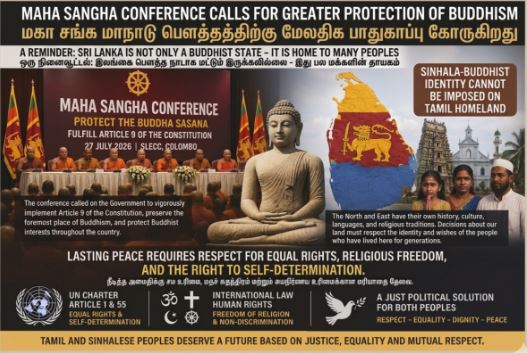
The resolutions adopted at the Maha Sangha Conference in Colombo on 27 July 2026 once again demonstrate the deep constitutional and political divide that has existed in Sri Lanka for decades. The conference called on the Government to more vigorously implement Article 9 of the Constitution, preserve the foremost place of Buddhism, and protect Buddhist interests throughout the country. It also raised concerns regarding constitutional reforms and archaeological lands in the Northern and Eastern Provinces. (Ground News)
For the Tamil people, this conference highlights a fundamental reality: Sri Lanka continues to define itself primarily as a Sinhala-Buddhist state.
The Sinhalese people have every right to preserve and promote Buddhism within their own society. However, many Tamils object to the use of state power to extend Sinhala-Buddhist institutions, archaeological projects, or religious policies into the Tamil-majority North and East without the consent of the local population.
The North and East have their own history, culture, languages, and religious traditions, including Hinduism, Christianity, and Islam. Many Tamils argue that decisions affecting these regions should respect the identity and wishes of the people who have lived there for generations.
The resolutions emerging from the Maha Sangha Conference reinforce concerns that constitutional protections for Buddhism are being interpreted as applying uniformly across the island, including in areas where the population is predominantly non-Buddhist. This underscores the continuing disagreement over governance, identity, and the political future of the North and East.
The principles of the UN Charter and international human rights law recognize equality, freedom of religion, and the principle of self-determination of peoples. Any durable political settlement should seek to protect the rights, culture, religion, and democratic aspirations of all communities.
The events of the Maha Sangha Conference serve as another reminder that the unresolved political conflict in Sri Lanka is not only about administration or development. It is also about competing constitutional visions, national identity, and the relationship between the state and the peoples of the island.
A lasting peace will require a political solution that respects the equal dignity and rights of both the Tamil and Sinhalese peoples, rather than one in which the constitutional preferences of one community are perceived by the other as being imposed upon them.