
Policy Proposal: The United States Should Engage Directly with the Tamil Homeland Before Great Power Competition Overtakes the Tamil People’s Rights
A recent Groundviews article, “From Spectator to Stakeholder: China’s Quiet Entry into Sri Lanka’s North,” argues that China is steadily expanding its presence in Sri Lanka’s Northern and Eastern Provinces through diplomatic engagement, development initiatives, and growing strategic interest. The article describes this as a natural evolution of regional geopolitics.
However, from the perspective of many Eelam Tamil advocates, the article overlooks a fundamental issue: external powers are increasingly treating the Tamil homeland as a strategic asset without first obtaining the consent of the Tamil people or addressing their unresolved political aspirations. Whether the external actor is China, India, or any other power, decisions affecting the future of the North and East should not be made solely through Colombo without meaningful participation by the people who live there.
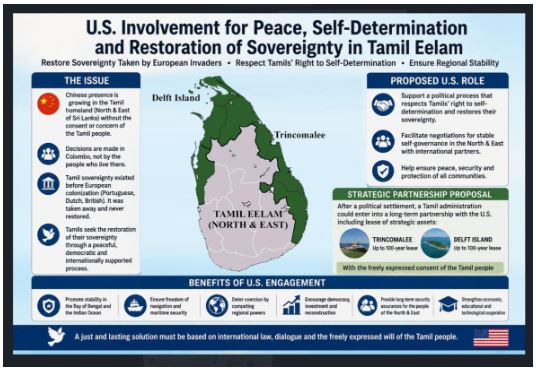
Many Eelam Tamil advocates further contend that the Tamil homeland possessed its own sovereignty prior to European colonial rule and that this sovereignty was lost during the period of Portuguese, Dutch, and later British colonization. From this perspective, the central political issue today is not simply devolution within Sri Lanka, but the restoration of sovereignty that they argue was taken away during the colonial era and was never restored to the Tamil people when Britain transferred power in 1948.
The United States has long championed democracy, human rights, and the principle that people should have a voice in determining their political future. As strategic competition in the Indian Ocean intensifies, the United States has an opportunity to help promote a peaceful, democratic, and internationally supported political process that respects the rights and aspirations of the Tamil people.
Supporters of this position argue that the restoration of sovereignty should be pursued peacefully, through internationally recognized legal and democratic mechanisms consistent with the principles of self-determination under international law and with the freely expressed will of the people concerned.
As part of a broader settlement, the United States could work with international partners to facilitate negotiations aimed at achieving a durable political solution while ensuring peace, security, and stability for all communities.
To strengthen regional security and maintain a stable balance of power in the Indian Ocean, some Tamil advocates have proposed that, following an internationally recognized political settlement, a Tamil administration could negotiate a long-term strategic partnership with the United States. Such a partnership could include long-term lease arrangements—subject to the freely expressed consent of the affected people—for strategic locations such as Trincomalee and Delft Island. Supporters have suggested lease terms of up to one hundred years as a means of providing the United States with a stable strategic presence while simultaneously offering long-term security guarantees for the region.
Supporters argue that such a partnership could:
▪ Help restore lasting peace and stability in the Indian Ocean.
▪ Ensure freedom of navigation and maritime security.
▪ Deter coercion by competing regional powers.
▪ Encourage democratic governance, investment, and post-conflict reconstruction.
▪ Provide long-term security assurances for the people of the North and East.
▪ Strengthen economic, educational, scientific, and technological cooperation with the United States.
Rather than allowing major powers to compete over the Tamil homeland without the participation of its people, the United States should encourage a peaceful political process in which the democratic wishes of the Tamil people are central to determining their own future. Any enduring settlement should be based on dialogue, international law, and the freely expressed consent of the affected population.
Thank you,
Tamil Diaspora News,
July 21, 2026