
The Five Ancient Shiva Temples of Sri Lanka Reflect the Island’s Pre-Buddhist Tamil Heritage
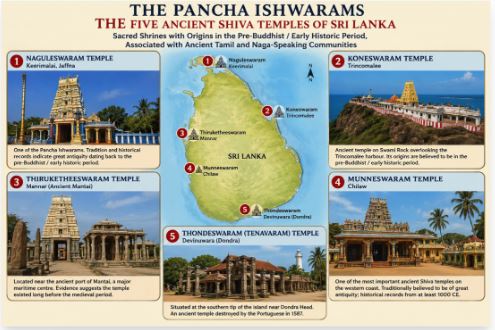
The ancient Pancha Ishwarams—Naguleswaram, Koneswaram, Thiruketheeswaram, Munneswaram, and Thondeswaram—stand as some of the oldest Hindu sacred sites in Sri Lanka. While the exact identities of their original builders remain unknown, historians and archaeologists broadly agree that these temples originated during the pre-Buddhist or early historic period, long before many of the island’s later kingdoms emerged.
Current archaeological and historical research indicates that these temples were closely associated with ancient Tamil- and Naga-speaking communities, who inhabited large parts of northern, eastern, western, and southern Sri Lanka and maintained extensive maritime trade and cultural links with South India and the wider Indian Ocean world.
The strategic locations of these temples are remarkable:
▪ Naguleswaram – Keerimalai (Northern Sri Lanka)
▪ Koneswaram – Trincomalee (Eastern coast)
▪ Thiruketheeswaram – Mannar (Ancient port of Mantai)
▪ Munneswaram – Chilaw (Western coast)
▪ Thondeswaram (Tenavaram) – Devinuwara/Dondra (Southern tip)
Their placement near major ancient ports strongly suggests that they formed part of a network of sacred centers serving both local populations and international maritime traders centuries before European colonial rule.
Although later Tamil dynasties—including the Cholas, Pandyas, and the Kingdom of Jaffna—expanded, restored, and endowed these temples, historians have not identified a single dynasty that originally founded all five. Rather, archaeological evidence indicates that these sites evolved over many centuries through continuous worship, rebuilding, and patronage.
Historical records also show that some Sinhalese rulers made donations to certain temples during different periods, reflecting the importance of these shrines as respected religious institutions attracting pilgrims from across the island.
A tragic chapter in this history occurred during Portuguese colonial rule in the sixteenth and seventeenth centuries. Several of the Pancha Ishwarams—including Koneswaram, Naguleswaram, and Thondeswaram—were deliberately destroyed, their treasures looted, and many of their ancient architectural features lost forever. The temples visible today are largely modern reconstructions built upon these ancient sacred sites.
The Pancha Ishwarams therefore represent far more than places of worship. They are enduring testimony to Sri Lanka’s deep and diverse civilizational history and to the presence of ancient Tamil and Naga communities on the island during the pre-Buddhist and early historic periods.
Preserving and studying these sites through objective archaeological research remains essential for understanding the shared heritage of Sri Lanka and the broader history of the Indian Ocean region.
US Tamil Diaspora
July 18, 2026
Pancha Ishwarams – www.wikipedia.org/wiki/Pancha_Ishwarams
Naguleswaram Temple – www.wikipedia.org/wiki/Naguleswaram_temple
Koneswaram Temple – www.wikipedia.org/wiki/Koneswaram_Temple
Thiruketheeswaram Temple – www.wikipedia.org/wiki/Ketheeswaram_temple
Munneswaram Temple – www.wikipedia.org/wiki/Munneswaram_temple
Thondeswaram (Tenavaram) Temple – www.wikipedia.org/wiki/Tenavaram_temple
The Five Ishwarams of Eelam (TamilNation) – www.tamilnation.org/heritage/eelam/fiveishwarams
Keerimalai Then & Now (Ilankai Tamil Sangam) – www.sangam.org/keeramalai
Sri Lanka’s Tirukoneswaram Kovil (Hinduism Today) – www.hinduismtoday.com/july-august-september-2026/sri-lankas-tirukoneswaram-kovil/