Link to X:https://x.com/diaspora_tamil/status/2071776606205497830
A referendum is meant to determine the will of a people—not to dilute it.
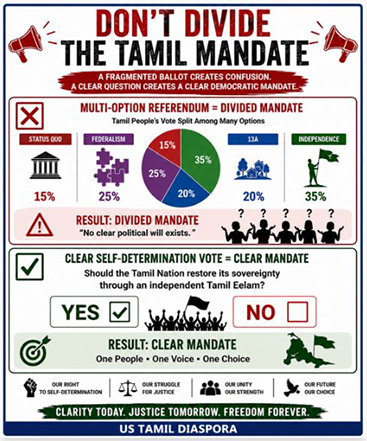
For Eelam Tamils, a multi-option ballot that includes the status quo, federalism, and independence risks splitting the vote and creating ambiguity where there should be clarity.
After decades of broken agreements, failed devolution, war crimes, and genocide allegations, the Tamil national question cannot be reduced to another exercise in managing competing options.
A divided ballot could allow others to claim that there is no clear Tamil mandate and postpone a just political solution yet again.
Unity is essential, but unity must be built around a clear democratic expression of the Tamil people’s right to self-determination.
Anything less risks preserving the very political structures that produced the conflict.
Why a Multi-Option Referendum Risks Undermining Tamil Self-Determination
We welcome the call for unity among Tamil organizations and agree that the Tamil people must speak with one voice. However, unity cannot be built upon a referendum framework that risks diluting the Tamil national mandate.
The Tamil national question is not a debate between the status quo, federalism, and independence. The Tamil people have already experienced decades of broken promises, failed agreements, unimplemented devolution proposals, and repeated violations of their collective rights. After genocide, war crimes, crimes against humanity, and systematic denial of their political aspirations, the central democratic question before the Tamil people is whether they wish to restore their sovereignty and govern themselves.
A multi-option referendum presents several dangers:
1. It divides the Tamil vote. Votes could be split among different options, allowing others to argue that there is no clear mandate for any political solution, particularly for independence.
2. It provides an escape route for Sri Lanka and the international community. Instead of confronting the root cause of the conflict—the denial of Tamil sovereignty—a fragmented result could be used to justify indefinite delays and further negotiations.
3. It revives previously failed solutions. Federalism, devolution, and constitutional reforms have repeatedly failed because successive Sri Lankan governments have refused to meaningfully share power or honor political commitments.
4. It shifts the focus from the rights of the Tamil people to the preferences of external actors. The right of self-determination belongs to the Tamil people, not to the international community or to states seeking a politically convenient outcome.
5. It weakens the clarity of the Tamil mandate. A referendum should produce a clear and unmistakable expression of the people’s will, not an ambiguous outcome that can be interpreted in multiple ways.
The principle of self-determination, affirmed in international law and reflected in UN General Assembly Resolutions 1514 and 2625, recognizes the right of peoples to determine their political status and pursue their economic, social, and cultural development. The Tamil people should therefore articulate their aspirations clearly and democratically, rather than dilute them in anticipation of what others may find acceptable.
The issue is not whether the international community will immediately support a particular outcome. The issue is whether the Tamil people are prepared to express their collective political will with clarity and conviction.
Unity is essential. But unity should be built around a clear, democratic, and principled position. Any referendum process that risks dividing the Tamil mandate or preserving the failed political structures of the past should be approached with great caution.