Tamil Sovereignty Is Not a Myth: Stokke’s Analysis Recognized a Political Reality Sarvananthan Tried to Dismiss
Tamil Diaspora News
Washington, D.C.
Tamil Diaspora News rejects Muttukrishna Sarvananthan’s attempt to dismiss Kristian Stokke’s analysis of Tamil Eelam state-building as biased or mythical. Sarvananthan’s criticism focuses narrowly on the LTTE and ignores the deeper historical and political reality: Tamil sovereignty, Tamil homeland, and Tamil demands for self-determination existed long before the LTTE.
Stokke’s analysis is important because it recognized that, during the conflict, Tamils had developed political, administrative, security, welfare, and governance structures in areas outside Colombo’s effective control. Whether one agrees with every action of the LTTE or not, these institutions reflected a larger Tamil national demand for protection, political order, and self-rule after decades of failed Sinhala-majoritarian rule.
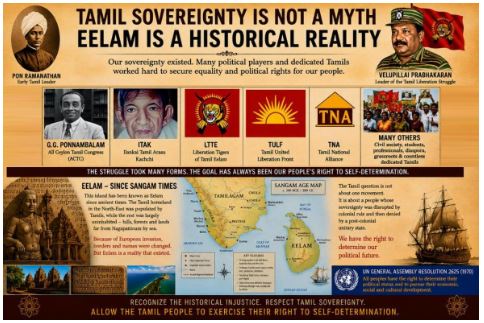
Sarvananthan’s argument wrongly reduces the Tamil national question to criticism of one movement. The Tamil struggle was not created by the LTTE. It was carried forward by many leaders, parties, movements, intellectuals, and ordinary people over generations.
From Sir Ponnambalam Ramanathan and G.G. Ponnambalam, to the All Ceylon Tamil Congress, Ilankai Tamil Arasu Kachchi, the Tamil United Liberation Front, the Tamil National Alliance, civil society leaders, disappeared persons’ families, student movements, diaspora organizations, and the LTTE, many Tamil political actors worked in different ways to seek equality, dignity, security, and political rights for the Tamil people.
Therefore, it is wrong to present Tamil Eelam only through the lens of the LTTE. The LTTE was one actor within a much longer Tamil national struggle. Tamil sovereignty existed before European colonial invasion changed borders, names, and political structures on the island.
The island has been known in Tamil historical memory as Eelam since ancient times. The Tamil homeland in the North-East was not an artificial idea created recently, but a lived political, cultural, and geographic reality connected to the Tamil people, the sea routes, and the wider Tamil world, including Nagapattinam and South India.
Sarvananthan criticizes Stokke’s article as biased and argues against describing LTTE-controlled areas as an emerging Tamil Eelam state. But his criticism of the LTTE does not erase the deeper historical reality of Tamil sovereignty, Tamil homeland, or the long political struggle of the Tamil people.
Tamil Diaspora News emphasizes that the Tamil question is not merely about one movement. It is about a people whose sovereignty was disrupted by colonial rule and then denied by a post-colonial unitary state. The proper international response is not to dismiss Tamil Eelam as a myth, but to recognize the historical injustice and allow the Tamil people to exercise their right to determine their political future.
Tamil sovereignty is not a myth. Eelam is a historical reality. The Tamil people’s right to restore their sovereignty remains a legitimate question before the international community.
Sarvananthan’s article specifically attacks Stokke’s research method and factual claims about LTTE governance, so this opening rebuts him by separating Tamil sovereignty from LTTE-only criticism.
Thank you,
Tamil Diaspora News.
June 9, 2026