Tamil Diaspora Warns: Supporting Anti-U.S. Narratives or Terror-Linked Regimes Could Carry Consequences for Future U.S. Travel
March 16, 2026
The US Tamil Diaspora today issued a strong statement urging Tamil politicians, activists, and commentators to exercise caution when publicly supporting regimes or narratives that oppose the United States and its democratic allies during the ongoing global tensions in the Middle East.
The statement follows growing debate within Tamil political circles regarding international alignments in the current conflict.
According to the US Tamil Diaspora, publicly advocating positions that appear to support regimes widely accused of sponsoring militant groups or operating under non-democratic religious authoritarian systems could have serious long-term consequences.
“The United States is a global democratic power with strict immigration and national security policies. Individuals who openly align themselves with regimes accused of supporting militant organizations may face future scrutiny when applying for U.S. visas or travel permissions.”
The Diaspora emphasized that Iran’s political system is governed by a religious clerical structure, which many international observers describe as a non-democratic religious government. Analysts often compare such ideological governance models with other systems where religious nationalism dominates state power, including the influence of Buddhist extremist forces in Sri Lanka, which have historically undermined democratic principles and minority rights.
The organization stressed that supporting the United States does not mean supporting war, but rather recognizing the geopolitical reality that democratic alliances play a major role in shaping global stability and security.
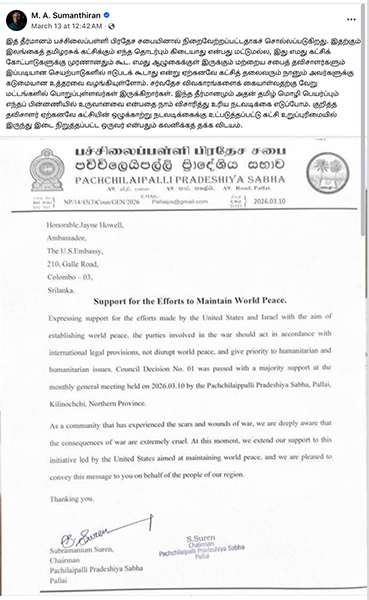
The statement also highlighted that the recent resolution reportedly passed by the Pachchilapalli Pradeshiya Sabha in Kilinochchi, expressing support for international efforts to maintain peace, demonstrates strategic political awareness among certain Tamil representatives.
“At a time when global alliances matter, Tamil leaders must understand that opposing democratic powers while appearing sympathetic to authoritarian regimes sends the wrong signal internationally.”
The US Tamil Diaspora further noted that the future political aspirations of the Tamil people — including discussions on sovereignty and self-determination — require constructive engagement with democratic powers, particularly the United States.
Many Tamil advocates believe that principles such as the 1960 United Nations Declaration on the Granting of Independence to Colonial Countries and Peoples (UNGA Resolution 1514) remain relevant frameworks for addressing the historic political status of the Tamil nation.
The organization concluded by urging Tamil politicians and commentators to act with strategic foresight and intellectual responsibility when making public statements on global conflicts.
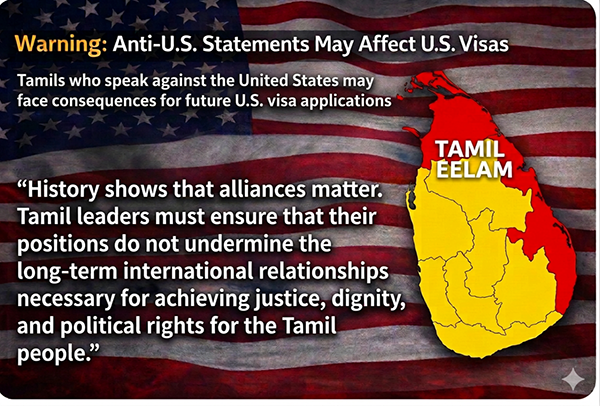
“History shows that alliances matter. Tamil leaders must ensure that their positions do not undermine the long-term international relationships necessary for achieving justice, dignity, and political rights for the Tamil people.”